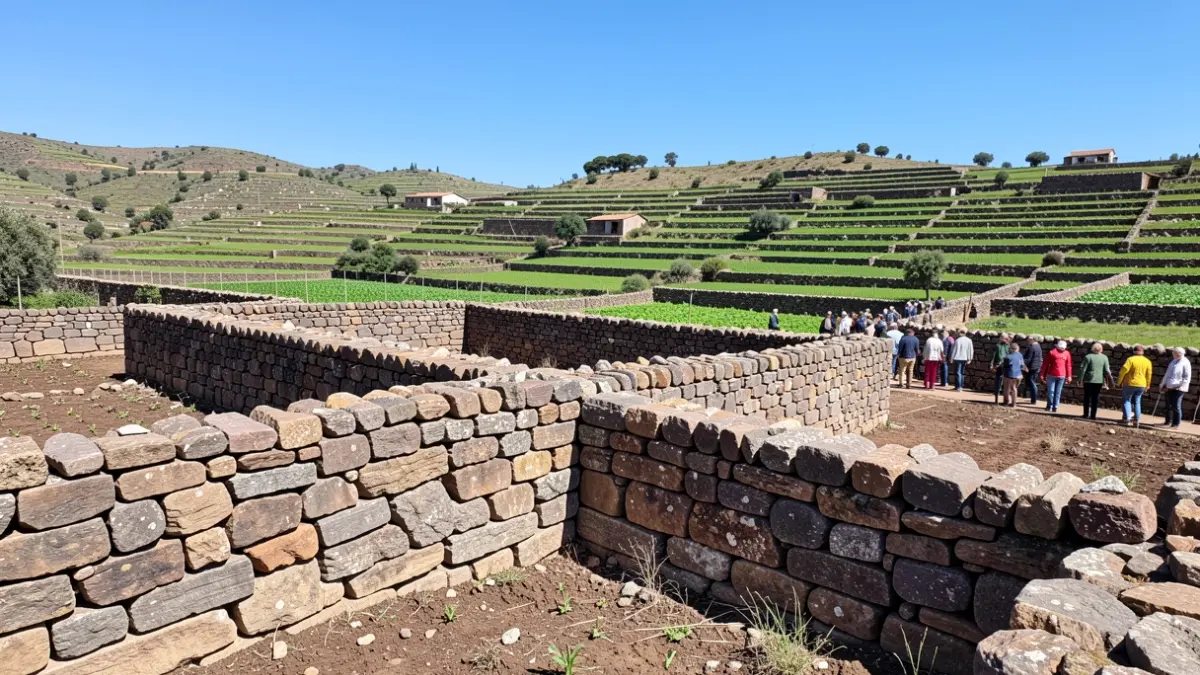
The municipality of Artenara, at the Los Lavaderos estate located in the Barranco de La Coruña, has seen one of its characteristic dry-stone walls restored. The winter storm, associated with 'Therese', had caused the partial collapse of this structure, accumulating stones at the base of the slope and affecting the stability of the terrain and the function of the agricultural terrace.
Promoted and financed by the Institute for the Integrated Management of World Heritage and the Biosphere Reserve of Gran Canaria of the Cabildo, this action aims to conserve the Cultural Landscape of Risco Caído and the Sacred Mountains of Gran Canaria and its traditional systems. The intervention is part of the Cabildo's work lines for the protection and enhancement of the island's cultural and ethnographic heritage.
The reconstruction, carried out by Agroforestal Atlántida, has restored the integrity of a wall approximately four meters high, crucial for the stability of the terrain and the functionality of the traditional agricultural terraces.
The work has been meticulously executed, employing traditional dry-stone construction techniques. The stones dislodged by the storm have been reused, repositioned manually to replicate the original typology of the wall. This method ensures the authenticity of the structure, preserves ancestral construction knowledge, and minimizes environmental impact by reusing existing materials.
The dry-stone technique is an essential component of Gran Canaria's historical landscape, representing valuable cultural heritage linked to the sustainable use of the territory. The recovery of these walls not only preserves a know-how passed down through generations but also contributes to the conservation of the agricultural landscape, a fundamental part of the identity of the island's highlands.
The area of the Barranco de la Coruña is a prime example of this Cultural Landscape, where terraces have historically been key to adapting crops to complex orography. Actions like this reinforce the functionality of these traditional infrastructures, increase the territory's resilience against extreme weather events, and safeguard the heritage values that define Gran Canaria, particularly within the Cultural Landscape of Risco Caído and the Sacred Mountains of Gran Canaria, recognized by UNESCO as World Heritage.