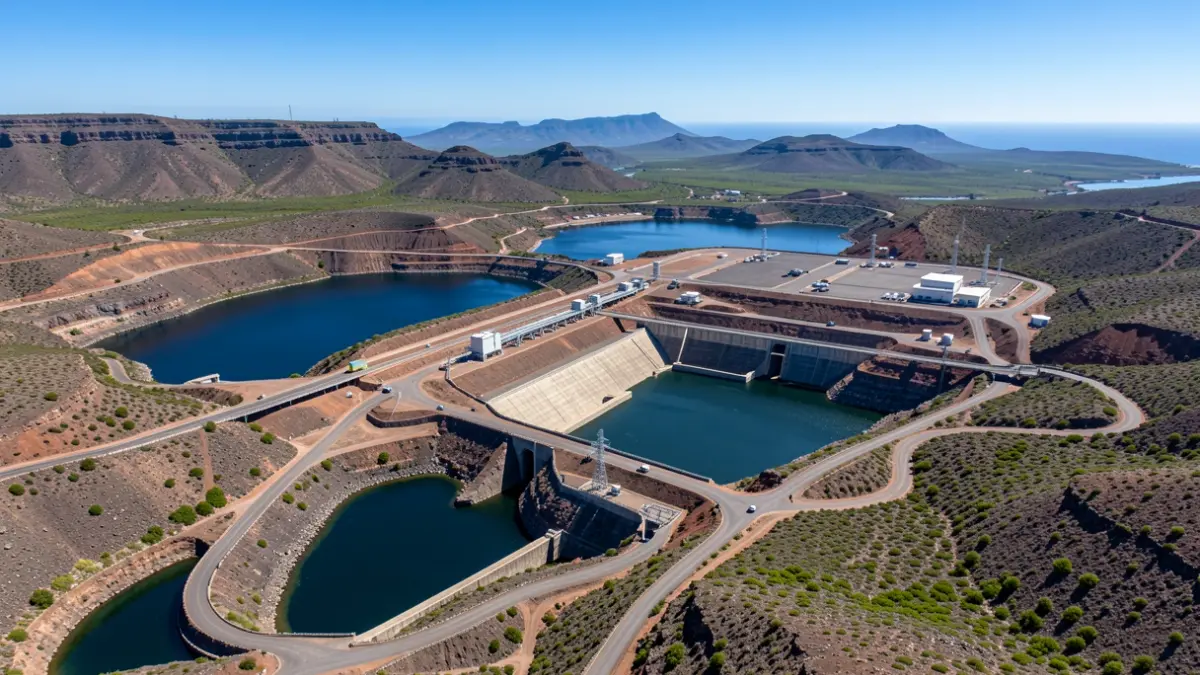
The works for the Salto de Chira hydroelectric complex, promoted by Red Eléctrica with an investment of nearly 600 million euros, have surpassed 60% completion. This project will transform the Soria and Chira reservoirs into a reversible power plant capable of storing renewable energy and returning it to the grid when needed, utilizing a 600-meter elevation difference.
Currently, hundreds of workers are focused on the Arguineguín ravine to begin filling the Soria reservoir with desalinated seawater in the coming months. The infrastructure will leverage the altitude difference between Chira (875 meters) and Soria (610 meters) to generate electricity. Once operational, the system is expected to enable renewable energy penetration to exceed 50% in Gran Canaria and provide an energy storage capacity of approximately 3.5 gigawatt-hours.
The process begins in Mogán, where seawater is captured off El Perchel beach and transported to the El Pajar desalination plant. This facility will produce water for the hydroelectric system and a surplus for agricultural and environmental uses. After desalination, the treated water will travel 17.5 kilometers, overcoming more than 600 meters in elevation to Soria through two pumping stages via underground pipelines and subterranean galleries.
The Soria reservoir, the largest in Gran Canaria, will serve as a regulating deposit and the starting point for pumping. Inside, a unique water intake structure has been built, connecting to the central's subterranean galleries. The reversible hydroelectric power plant, located in a large underground cavern, will have a total capacity of 200 megawatts and six hydraulic units. It will use surplus renewable energy to pump water from Soria to Chira, storing potential energy, and release it through turbines when renewable generation is insufficient.
The hydraulic connection with the Chira dam, which gives the project its name, is made via a vertical forced conduit of 375 meters, creating a net head of 350 meters. The Chira reservoir, at 875 meters altitude, will be the upper energy storage point, determining the system's maximum storage capacity at approximately 16.8 hours of autonomy.
The electricity generated will be evacuated through a new substation in Santa Águeda and a 220-kilovolt double-circuit line. The project has minimized visual impact by completely burying the power line between reservoirs and reducing surface supports. The system is expected to be operational in 2028, completing a closed circuit of over twenty kilometers between the sea and the dams to store energy and provide stability to Gran Canaria's electrical system.
Subterranean work, initiated in October 2023, has advanced significantly, completing 8 kilometers of tunnels and most of the cavern. Only 6.7% of the material remains to be extracted. Surplus materials are managed for the restoration of degraded areas, such as the San José quarry and sites affected by the construction of the GC-1.
The project minimizes environmental impact by developing most facilities underground and burying the power line. Measures are in place to protect the marine environment, archaeological heritage, and sensitive species, along with an ecological restoration program and the creation of a nursery with native species to restore soil fertility and create ecological corridors.