This pact, now in its third edition following those signed in 2018 and 2023, establishes a framework of shared commitments between the island institution and the livestock sector. Its objective is to foster active collaboration to develop controlled grazing that combines food production with important environmental goals.
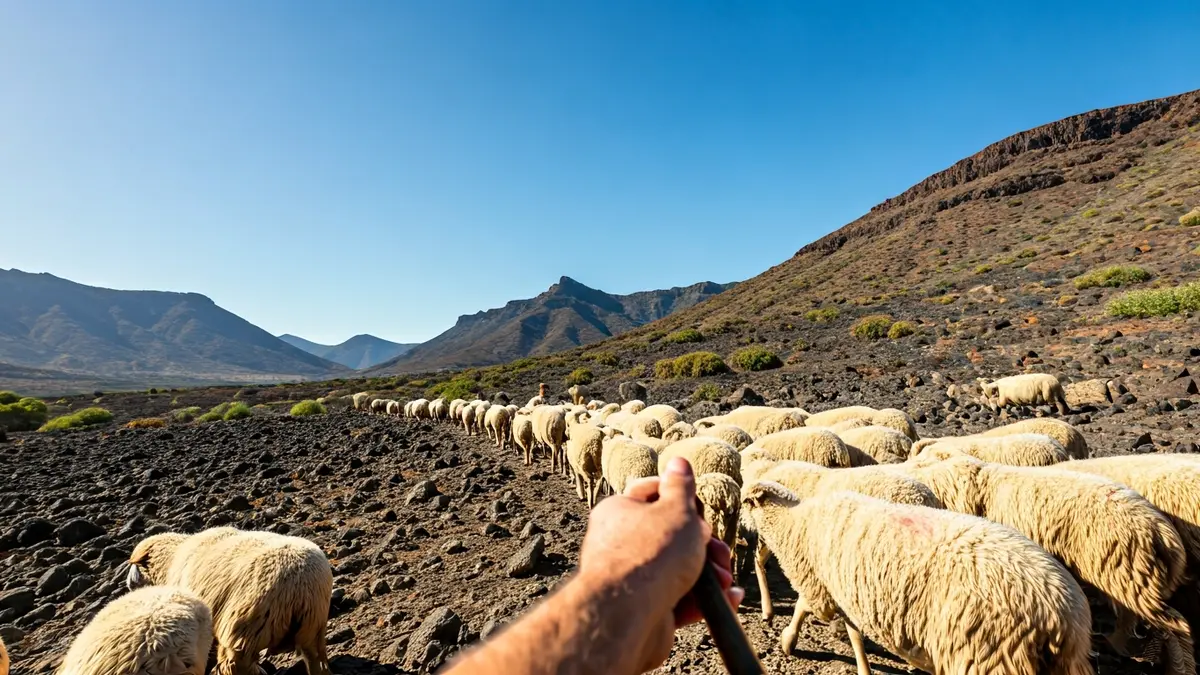
Within this agreement, the Cabildo will continue to provide financial compensation to shepherds for their vital work in fire prevention through the Gran Canaria Mosaico program. Furthermore, efforts will be made to improve and expand pastures, support transhumance, and recognize and value livestock trails as intangible cultural heritage. Generational succession will also be strengthened through the continuation of the Shepherding and Livestock School and collaboration with Canarian universities for scientific research.
“"The recognition from the Cabildo de Gran Canaria is very important because it helps improve the relationship with the primary sector. Now there is more communication, they grant us land, and they let us work with more freedom. This commitment is a brotherhood between both sectors, which is why I consider it fundamental to maintain dialogue."
For their part, shepherds commit to preventing livestock from becoming feral and to removing feral animals from the natural environment, thus contributing to responsible land management. Ruyman Mena Sánchez highlighted the agreement's importance in recognizing the work in fire prevention, as dry grass can burn, and noted that the number of shepherds and the hectares of intervention increase each year.
“"Gran Canaria owes a debt to its shepherds, who for centuries have contributed to producing our food, preserving our traditions, and maintaining the balance of our landscapes."
The island president, Antonio Morales, emphasized that this agreement is not a starting point but the result of sustained joint work, consolidated through previous agreements and continuous public policies supporting the sector. He stressed that ordered grazing has become an indispensable tool for the future, not only for its productive value but also for its essential role in preventing large fires and managing the territory. Morales highlighted that, for the fifth consecutive year, the Cabildo remunerates livestock families for their contribution to fire prevention, truly recognizing the environmental service they provide to all of Gran Canaria society.
The renewal ceremony, held at Finca de Osorio, was attended by Antonio Morales; the Minister of Environment, Climate, Energy, and Knowledge, Raúl García Brink; the Minister of Primary Sector and Food Sovereignty, Miguel Hidalgo; and approximately 40 shepherds linked to the Gran Canaria Mosaico program, as well as sector associations. Representatives from Tenerife and experts from the Mosaic Territories Network Conferences also attended, fostering knowledge exchange.
The renewal of this agreement is part of the Gran Canaria Mosaico strategy for preventing large forest fires, promoted by the Cabildo de Gran Canaria. Its goal is to promote the recovery of diverse, inhabited mosaic landscapes with reduced risk, based on the balance between natural spaces, biodiversity conservation, and agricultural, livestock, and forestry activities, as well as adapting society to coexist with fire. This approach has been a central theme of the Mosaic Territories Network Conferences, where experts from Spain and Portugal exchanged experiences, highlighting this agreement as an example of best practices.