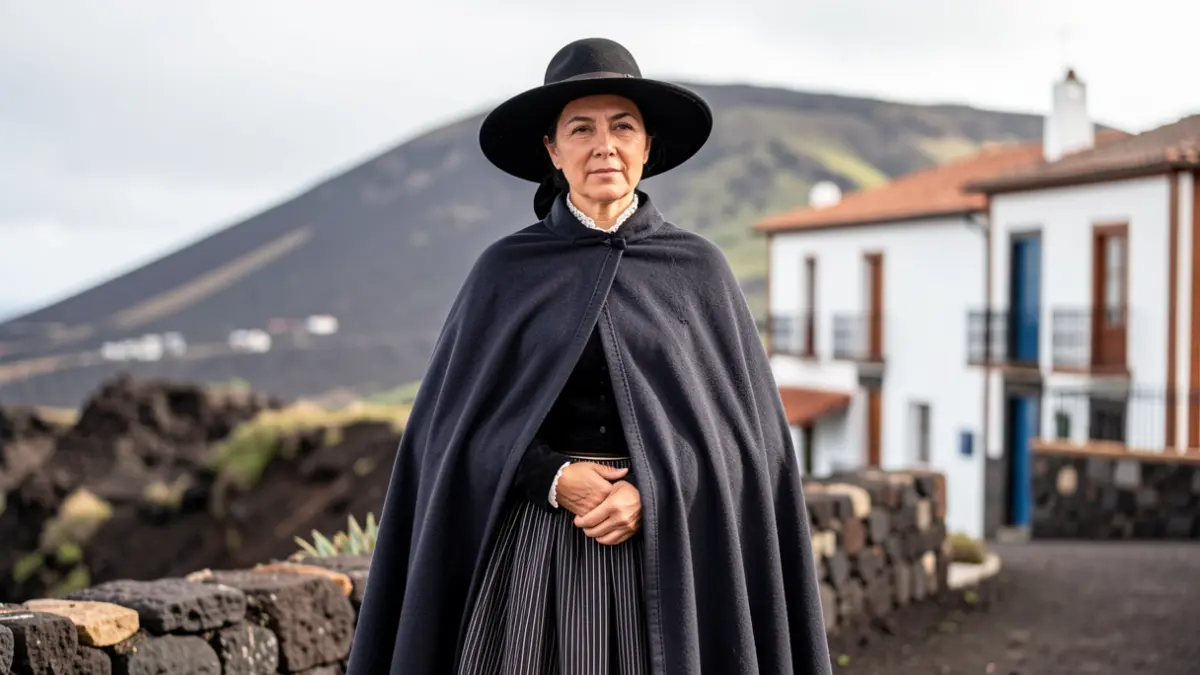
The survival of ancient attire is a key cultural legacy for ethnographic heritage. La Palma distinguished itself in the Canary Islands by preserving the 'tapada' and the 'manto y saya' variant as daily female attire until the mid-19th century. Although romantic currents at the end of that century recorded it as a custom, its daily use declined, and it is now integrated into the island's traditional dress.
This garment, also known as 'tapadas de un ojo', 'cobijado', or 'encubiertas', was prohibited in Spain during the 16th, 17th, and 18th centuries through various royal decrees. Despite repressive laws and fines, these regulations did not seem to take deep root in La Palma. The distance from the metropolis, the absence of conflicts, and local social acceptance explain the preservation of its use on the island.
The 'tapada' involved wrapping the head, chest, and face with the mantle, seeking anonymity and coquetry. The difference from the 'manto y saya' is that in the former, the face is voluntarily hidden (black mantle and saya, no hat), while in the latter, the face is uncovered, different colors are used, the mantle is worn over the shoulders or head, and it is complemented by a hat. The latter is a later variant that coexisted in the 19th century.
Several authors suggest a Muslim origin for this garment, but Carmen Bernis disagrees, pointing out that Spanish women began covering their faces half a century after the expulsion of the Moors. While Muslim women covered themselves due to social imperatives, Spanish women did so to enjoy freedom and out of coquetry, in rebellion against customs and laws. For them, it was not a sign of modesty but of 'provocative coquetry'.
In La Palma, the 'manto y saya' consists of three petticoats and a piece worn over the shoulders or head. The 'tapada' is distinguished by hiding the face with the mantle. Documents such as an inventory from 1642 mention 'vna tapada' who made an anonymous donation to the Sanctuary of Nuestra Señora de las Nieves, suggesting the early establishment of this attire on the island.
In the Valle de Aridane, the 'manto y saya' was an object of dowry and inheritance. Wills from the 18th and 19th centuries detail bequests of these garments. A curious reference from 1765 describes men dressed as women with 'mantos y sayas' during the Bajada de la Virgen, suggesting a possible carnival manifestation. Documentarily, 'manto y saya' refers to the two pieces, while 'tapada' refers to the act of hiding the face.
A lawsuit in Santa Cruz de La Palma between 1764 and 1781 reveals that figures from high society, such as doña Tomasa de Sotomayor, used the mantle to hide their faces, confirming that the upper classes of La Palma adopted the 'tapada' persona. This corroborates that, during the 17th and 18th centuries, the 'manto y saya' and the 'mantle to cover the face' were common in La Palma among women of various social strata.
In the 19th century, deeds from 1834 document the 'manto y saya' as a prominent part of the female trousseau. Around 1846, Antonio Lemos Smalley describes in 'Usos y costumbres de los aldeanos de esta isla de La Palma' how women wore 'mantas y sayas y sus sombreros' at weddings, marking the first documented mention of the hat as an accessory. Later prints and photographs confirm this attire, with the mantle worn over the shoulders rather than the head, especially in the late 19th and early 20th centuries.
Today, the 'manto y saya' is worn with a top hat, with the exception of the style from Los Llanos de Aridane. The act of hiding the face, the 'tapada', has become part of the social and ethnographic heritage of La Palma.