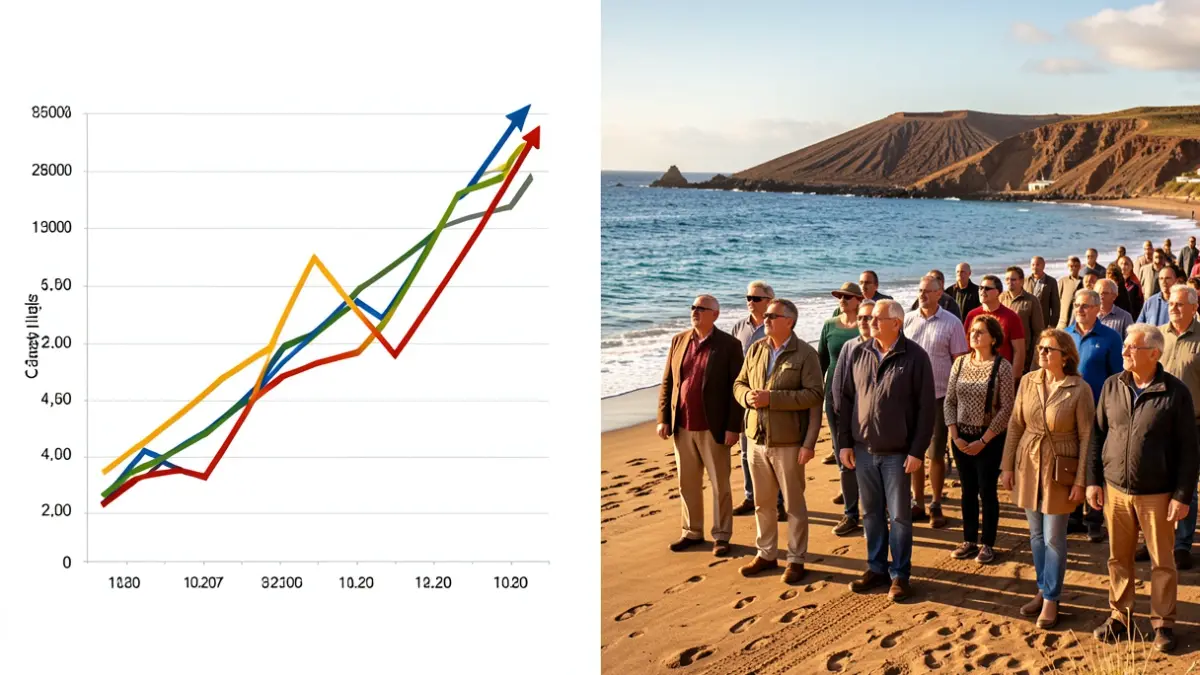
The disposable income level in Canary Islands households has seen a notable increase of 19% between 2022 and 2025, rising from an average of €2,321 to €2,755 per month. Concurrently, the percentage of the population at risk of poverty has decreased, standing at 17.6% in 2025, compared to 20.5% in 2022.
For the first time, this edition of the survey includes the AROPE indicator (risk of poverty or social exclusion) in line with the Europe 2030 objective. This indicator considers individuals at risk if they are in at least one of the following situations: at risk of poverty, severe material or social deprivation, or living in households with low work intensity. The 'at risk of poverty' component remains the same as in the Europe 2020 strategy, but there are changes in 'severe material and social deprivation' and 'households with low work intensity'.
Overall, 28.7% of the population in the Canary Islands is at risk of poverty or social exclusion. By island, La Palma records the highest value at 38%, while La Gomera presents the lowest at 24.8%.
The poverty risk threshold in the Canary Islands has been set at €797 per month for 2025, a 17% increase from 2022 (€680). With this threshold, 17.6% of the Canary Islands population is at risk of poverty. By island, Fuerteventura has the lowest percentage (15%), while El Hierro and La Palma have the highest (28% and 22% respectively).
Severe material and social deprivation affects 12.7% of the population in 2025. La Palma leads this indicator with 19%, and La Gomera shows the lowest figure at 5.5%. This deprivation is defined by the lack of at least 7 out of 13 considered concepts related to the household (holidays, food, adequate heating, car, furniture replacement, unexpected expenses, housing/credit payments) or the individual (clothing, shoes, social life, leisure, personal spending, internet access).
11.6% of the population aged 0 to 64 lives in households with low work intensity. El Hierro records the highest figure (21.3%), and Lanzarote the lowest (6.9%). More than half of Canary Islands households (35% with some difficulty and 25% with much difficulty) report having problems making ends meet.
Expectations for future income are moderately optimistic: 20% of households anticipate an improvement, 59% expect them to remain the same, and 14% predict a worsening.
Regarding quality of life, 75% of those aged 16 and over feel safe walking alone at night. Satisfaction with personal relationships is high (7.8), while recreational areas receive a lower rating (6.1).
Homeownership continues its downward trend, falling to 58% in 2025 (from 73% in 2004), while renting increases to 32%. Internet access reaches 89% of households and mobile telephony 98%. The most frequent household type is a couple with children (34%).
In terms of health, 63% report good or very good health. 36% have completed higher education. The unemployment rate has fallen to 12.6% (from 14.6% in 2022), and 84% of employees have permanent contracts, reflecting greater job stability.
Gender gaps persist in household chores: women always handle washing, ironing, and putting away clothes in 43% of cases, compared to 25% of men.
Recycling is consistently practiced by over 62% of the population, a slight improvement from 61% in 2022, reaching 69% for batteries.
The survey, which included 4,630 households and 11,181 individuals, is a continuation of previous statistical operations and is part of the Canary Islands Statistical Plan. Its objective is to study and monitor income levels, distribution, living conditions, and situations of social inequality and poverty in the Canary Islands.