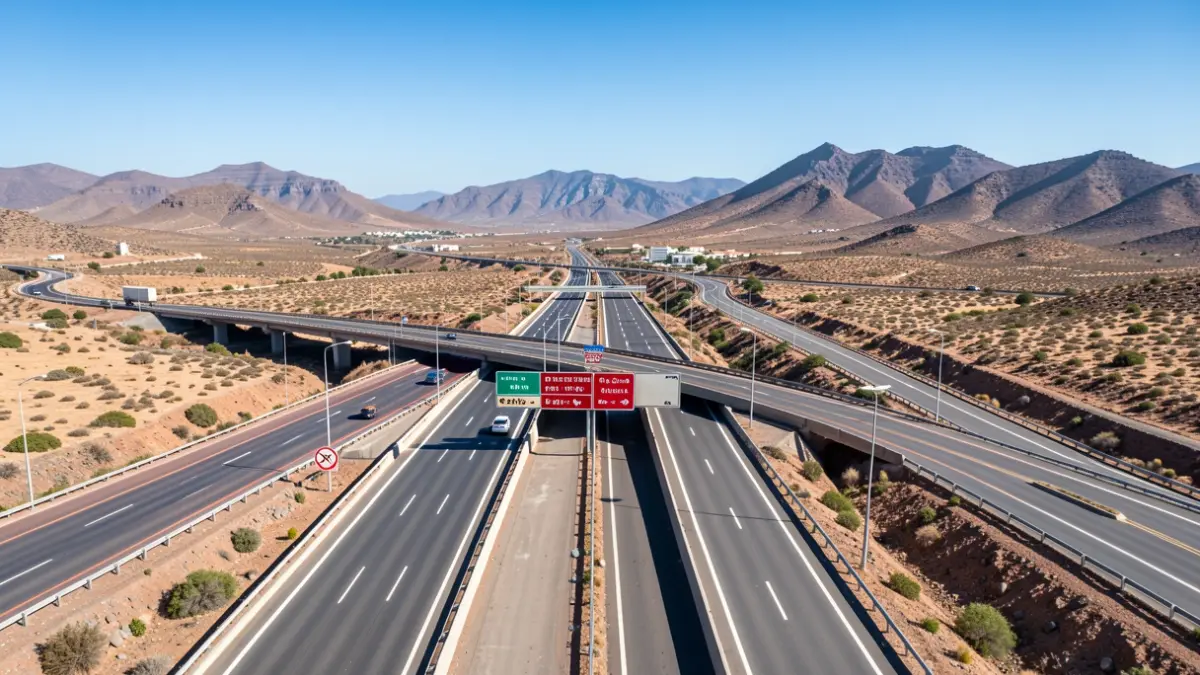
The Cabildo of Gran Canaria has begun signaling the closures and diversions that will affect the GC-3 starting next Sunday, August 2nd. The waterproofing works on the two decks of the Guiniguada Viaduct are essential to ensure the conservation and safety of this key infrastructure for island mobility. The works will involve the complete closure of the viaduct for 24 hours, first for 15 days in the northbound direction (towards Tamaraceite or Arucas) and subsequently for another 15 days southbound. Much of the GC-3 traffic will be diverted to the capital's Avenida Marítima.
Operators from Lopesan, the company awarded the contract, have already placed the first indicative signs. These are located at the entrance of the Santo Domingo tunnel (past Salto del Negro) on the carriageway towards Tamaraceite, and on the road of the San José tunnels (GC-31) on the carriageway ascending from the Avenida Marítima. More signs will be added in the coming weeks to raise awareness among drivers about the need to find alternative routes.
Before starting the work, operators conducted precise topographical measurements using a georadar on the over 18,000 square meters of the two decks. The georadar allowed for the detection and marking of small irregularities in the concrete to be addressed during the waterproofing process.
Due to the complexity of the tasks, which will be carried out during daylight hours, traffic will be cut off 24 hours a day over the deck under construction. The full closure is expected to last throughout August. The first deck to close, starting August 2nd, will be the one closest to the sea (northbound), and after 15 days, the land-side deck (southbound) will close, with its reopening anticipated around August 30th.
The Technical Service of Public Works and Infrastructure designed the schedule based on a traffic study indicating that August, particularly Sundays and the first working days of the week, experiences the lowest average daily vehicle intensity on this road. It is estimated that between 5,000 and 10,000 fewer vehicles travel during this period compared to the rest of the year, and on August Sundays, up to 20,000 fewer than on weekdays in other months.
The technical report notes that the anticipated disruptions will be similar to those typically occurring during peak hours on other island roads, and the impact on mobility is considered manageable through the use of alternative routes.
During the northbound closure, traffic will be primarily diverted through the San José tunnels (GC-31) to the Avenida Marítima, and from there, via the Julio Luengo tunnels, towards the GC-2. For the southbound closure, diversions will be via the La Ballena tunnels (GC-23) to Julio Luengo up to the Avenida Marítima and then to the GC-1. Maintaining access to the Lomo Blanco neighborhood and from there to Tafira or El Zurbarán is being considered, but only via the GC-31.
This waterproofing work is part of the overall project for resurfacing 11 kilometers of the Ring Road, awarded last year for 18,722,343 euros. The waterproofing, executed by Lopesan Asfaltos y Construcciones, corresponds to Lot 2 and represents an investment of 2.2 million euros.
To minimize disruptions, the Cabildo requests maximum citizen cooperation and recommends planning trips in advance, consulting alternative routes, and using public transport whenever possible.