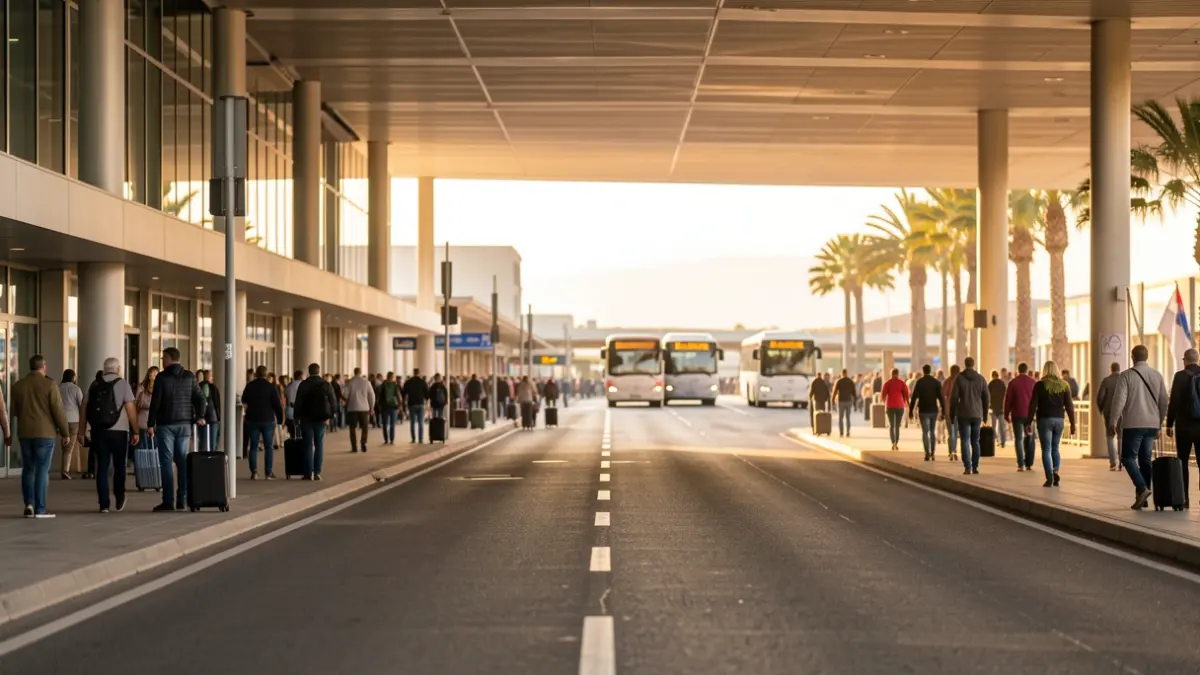
The Directorate General of Transport and Mobility of the Government of the Canary Islands has formally requested a meeting with Aena, the airport operator, before the end of July. The objective is to urgently review the new system implemented that restricts bus access and parking at Tenerife South Airport. This request arises from incidents recorded last weekend, which caused queues of over half an hour for tourists, and from the Executive's concern about the repercussions on collective transport, operating companies, airport mobility, and the island's tourism image.
María Fernández, Director General of Transport and Mobility, considers it essential to initiate a working group with Aena to analyze the failures, evaluate the consequences of the so-called 'tasazo' (price hike), and agree on solutions to prevent problems from recurring. The Canarian Executive emphasizes the need for airport access management to align with the specific operations of the Canary Islands, where buses are the primary mass public transport alternative connecting terminals with urban and tourist centers.
The urgency of the meeting is further heightened by the lack of institutional information received by the Government regarding the definitive implementation of the system. Canarias had expressed its reservations since December 2025 and, in January 2026, requested Aena to temporarily suspend the measure and convene the Airport Coordination Commission. In that commission, Aena reportedly communicated a postponement and the study of solutions to mitigate the impact, although the regional government claims not to have received subsequent details.
The main point of contention is that the current regulation does not account for factors common at airports like Tenerife South, such as flight delays, international passenger document checks, baggage delivery, or the grouping of travelers from different flights, which may require longer stays than planned. The Executive warns that these delays, not always attributable to transport companies, could increase costs, complicate transfer organization, and harm tour operators. There is also concern that a more complex operation for buses might favor the use of taxis, rental cars, and private vehicles, leading to increased congestion.
The Government became aware of the incidents through transport companies and media reports. Therefore, it insists on holding the meeting before the end of July to rectify the situation and prevent the system from continuing to generate problems during the peak tourist season. The Ministry of Public Works, Housing, and Mobility argues that any regulation should enhance collective transport, not hinder it, and points out that the current situation affects regular passenger transport, drivers' working conditions, tourism activity, and the image of the Canary Islands as a destination.
María Fernández reiterates that the meeting should serve to halt new incidents and agree on a solution before the system is consolidated. She emphasizes that the operations of Canarian airports require greater flexibility, mentioning flight delays, international passenger document checks, and the coordination needed to pick up travelers from multiple flights as factors that can exceed the planned grace period without it being due to transport companies' malpractice. The Government of the Canary Islands requests a halt to the implementation of problematic aspects, a resumption of institutional dialogue, and the definition of a system that balances the efficiency of Tenerife South airport with the normal operation of buses.