The Impulsa Maspalomas project, a sustainable tourism strategy funded by Next Generation EU, has introduced various technological improvements in the area. These actions, led by the Gran Canaria Island Council in collaboration with the San Bartolomé de Tirajana City Council, combine energy transition, digitalization, and service enhancements with an investment of 5.5 million euros.
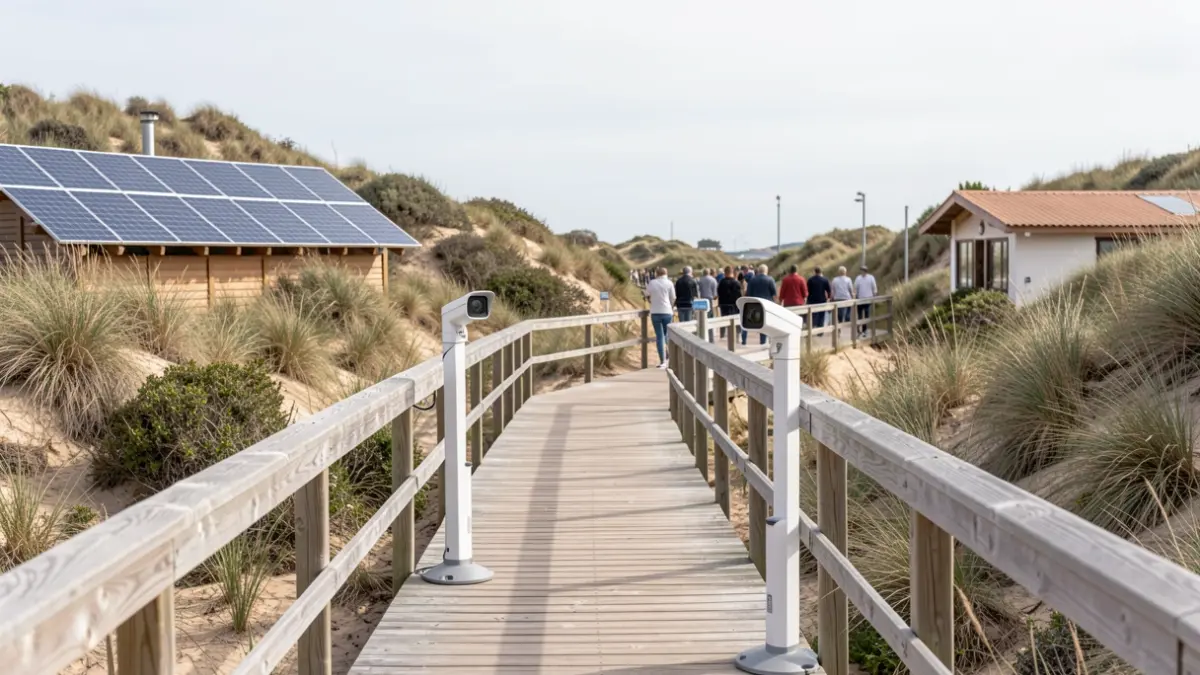
Within the Maspalomas Special Natural Reserve, videometry cameras have been installed to alert authorities if individuals are detected outside permitted transit zones. Additionally, a new public address system is used to educate visitors on respecting the environment. For emergency safety, five solar-powered SOS posts have been deployed, directly connected to 112.
The dune trails now feature educational audio guides accessible via QR codes and eight sensors that monitor visitor flow in real-time through their mobile devices. 43 smart solar-powered bins have also been placed along promenades and beach access points, signaling when they are 80% full to optimize waste collection.
The project also includes the installation of three photovoltaic plants integrated into canopies, each equipped with five charging points for electric vehicles. These plants, located on Granada Avenue, Gran Canaria Avenue, and Miramar Square, are estimated to generate electricity equivalent to the consumption of approximately 69 homes.
Furthermore, 244 light fixtures and 48 projectors on Paseo Costa Canaria have been upgraded to high-efficiency LED technology, resulting in a 60.5% reduction in energy consumption and preventing the annual emission of 54.3 tons of carbon dioxide.
The president of the Gran Canaria Island Council, Antonio Morales, highlighted the proposal's significance for Gran Canaria's tourism sustainability, while the Minister of Environment, Raúl García Brink, emphasized the enhancement of the area's green reputation. The mayor of San Bartolomé de Tirajana, Marco Aurelio Pérez, underscored the use of technology for societal benefit.