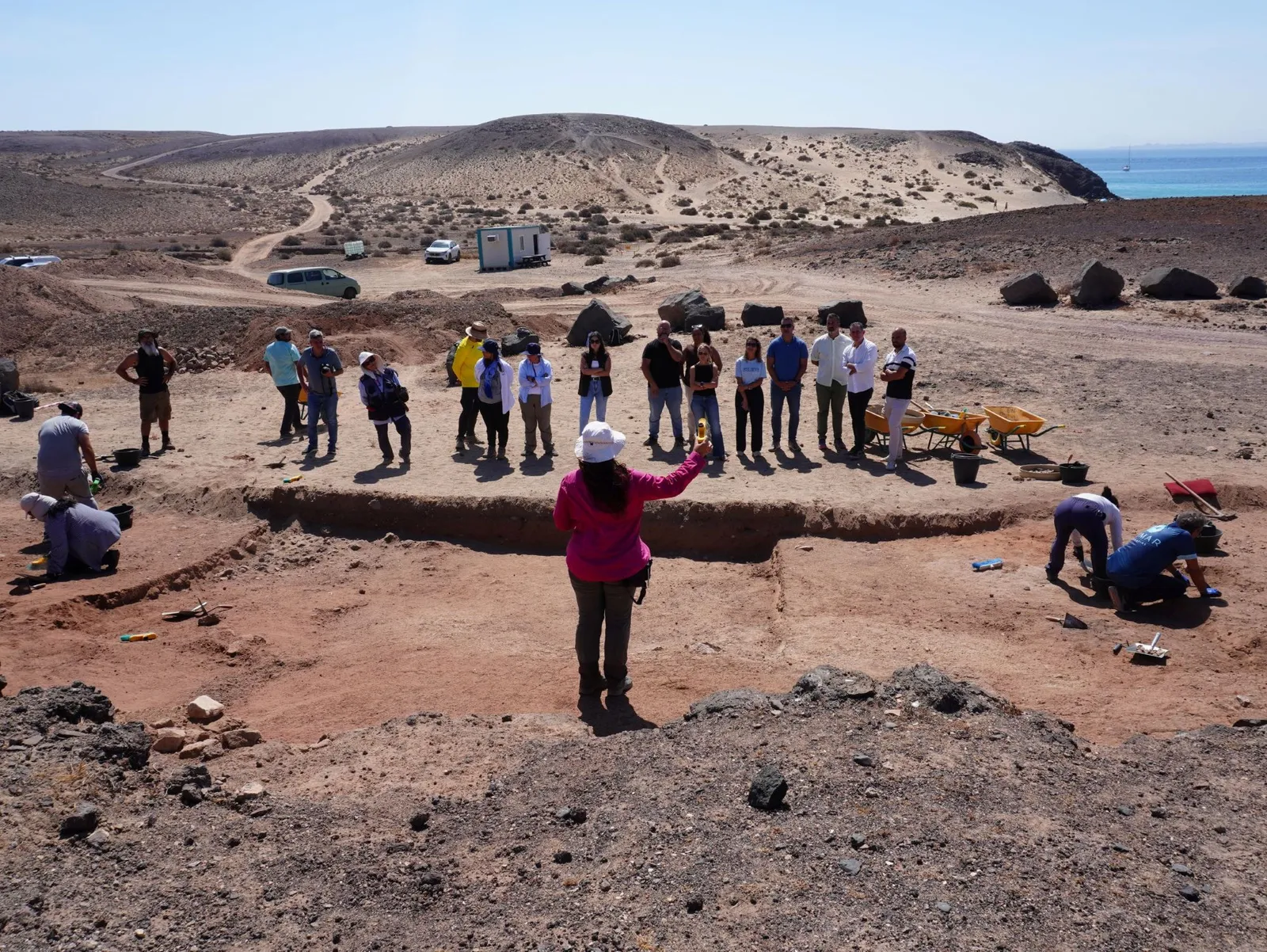
After a month of fieldwork, interventions in three different areas of the site have led to the location of three new hydraulic structures in the ravine, a lime store, and pavements linked to the urban organization of this first European settlement in the Canary Islands during the 15th century.
The campaign, part of a cooperation agreement between the Government of the Canary Islands, the Yaiza City Council, the University of Las Palmas de Gran Canaria (ULPGC), and the University of La Laguna (ULL), focused on resizing the enclave and searching for new hidden spaces based on recent geophysical radar studies.
Miguel Ángel Clavijo, Director General of Culture and Cultural Heritage, and Silvia Santana, Councilor for Heritage of the Yaiza City Council, visited the archaeological site along with the research co-directors to learn about the latest developments.
Clavijo highlighted the site's richness, stating, “At San Marcial del Rubicón, we are fortunate to have written sources and, at the same time, an extraordinary excavation project that has now reached its seventh campaign.” He added that this allows them to “rigorously certify what historical chronicles relate and, on the other hand, helps us discover and understand the spaces these communities occupied to live and prosper in a particularly complex environment, marked by water scarcity.”
Santana assured that “San Marcial del Rubicón never ceases to surprise us” and emphasized institutional cooperation and the council's swift support with heavy machinery to facilitate the work. “We are confident that this campaign will yield great results again,” she stressed.
A main focus was the Barranco de Los Pozos, where the objective was to locate hydraulic structures. Archaeologist Esther Chávez clarified that “two new wells and a third structure also related to water use” have been found.
Furthermore, an expanded intervention area revealed a lime store linked to an earlier lime kiln, providing insights into the settlement's daily life. Another area yielded a plaza with rammed earth pavements, possibly an access point to the church.
During the excavations, a large number of diverse materials were recovered, including human and animal bone remains, malacofauna, ceramic fragments, and metal pieces such as coins and clothing pins.
Following the fieldwork of this seventh campaign, the ‘Proyecto Rubicón’ will continue with laboratory work. The recovered artifacts will be transferred to the public universities of the Canary Islands for study, which will be crucial for precisely determining the scope of the located structures and deepening the understanding of the site where the conquest of the Canary Islands began.