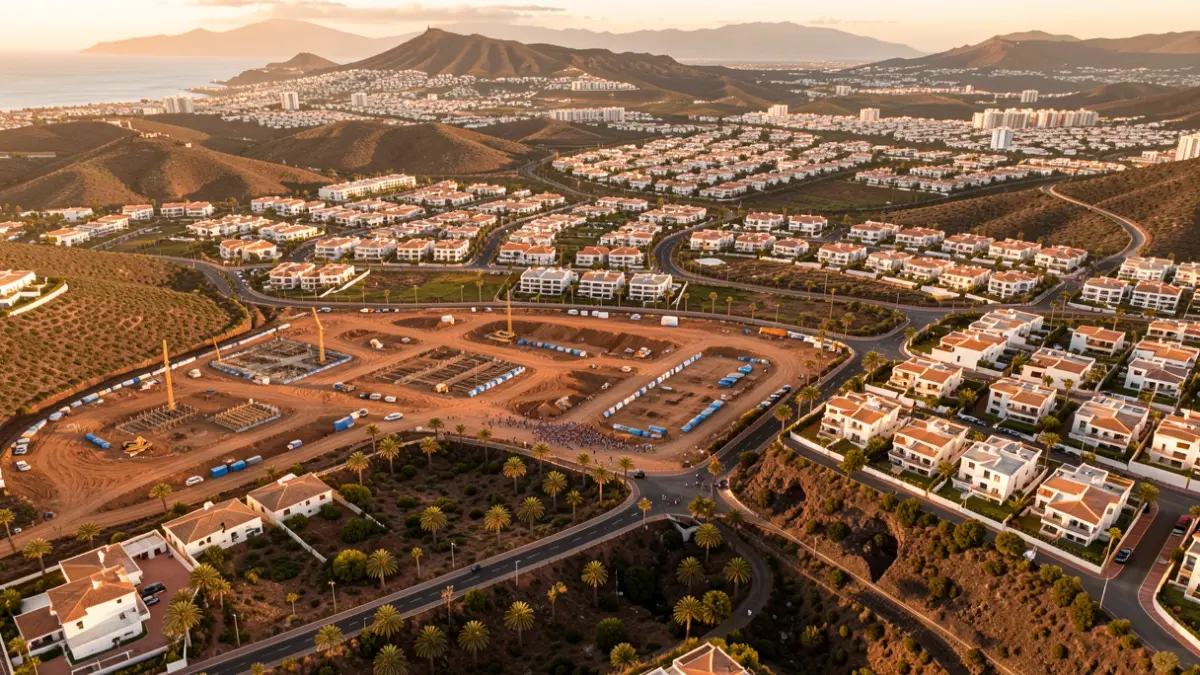
The municipality of Adeje, in Tenerife, has launched an ambitious urban development initiative to create a new residential area within its urban center. The City Council has initiated the procedures for the urbanization of two partial plans, El Calvario and Adeje 2020, which together cover an area of 142,441 square meters, equivalent to about 30 football fields. This project is presented as one of the most significant residential developments on the island, addressing a housing crisis, and is expected to accommodate approximately 2,800 people, including a portion designated for social housing (VPO).
The partial plans, currently in different stages of development, have seen decisive progress. The El Calvario Partial Plan (formerly El Galeón), spanning 53,636 square meters, is the most advanced. The Official Provincial Gazette (BOP) has published the City Council's announcement formalizing the processing of this initiative, opening a public exhibition period for the establishment of the compensation board. This entity, composed of landowners, will define the buildings and public facilities to be constructed.
The El Calvario Partial Plan includes garden city-style housing, comprising collective residential buildings and single-family homes (townhouses, chalets) of low to medium density, characteristic of the El Galeón residential area, designed for around a thousand people. According to Manuel Luis Méndez, Councilor for Presidency and Territorial Planning of Adeje, this plan, approved with the municipality's General Urban Planning Plan (PGO) in 2008, does not include social housing as it was not required by the regulations at that time. The project also incorporates small commercial centers and service premises to supply the urbanization. The compensation board will be obligated to cede spaces for general systems and public open areas. Furthermore, the City Council plans a 35,000 square meter thermophilic forest in the vicinity. No tourist accommodations are planned, as these are concentrated on the coast of Adeje.
Once the landowners' representative and management body is established, the urbanization design will proceed, involving the reorganization of original plots, definition of final buildable parcels, and determination of areas to be ceded to the City Council for streets and parks. Subsequently, technical plans for basic services such as paving, lighting, sewage, and telecommunications networks will be drafted, followed by earthmoving, construction of internal road infrastructure, and the final phase of building residential structures and public facilities.
The larger plan is Adeje 2020, covering 88,805 square meters. In this case, 40% of the area will be allocated to affordable social housing (VPO). The City Council's Environmental Body has approved the public information process for the environmental document, with a 45-business-day period for public comments. Under municipal supervision, this plan is expected to house approximately 1,800 people. Unlike El Calvario, the City Council will directly oversee the urban planning process, as the land is more widely distributed, negating the need for a compensation board.
Both projects represent a significant boost for housing construction in Tenerife, addressing concerns about the housing crisis, particularly in the southern municipalities of the island. Manuel Luis Méndez emphasizes that they will also substantially improve urban mobility in the mid-slope casco (historic center) and enhance public amenities. He notes that there are few declared developable and already-ordered land reserves in Tenerife like these. It is estimated that the first phases of both plans could be visible within two to four years, positioning Adeje at the forefront of residential bed creation on the island.