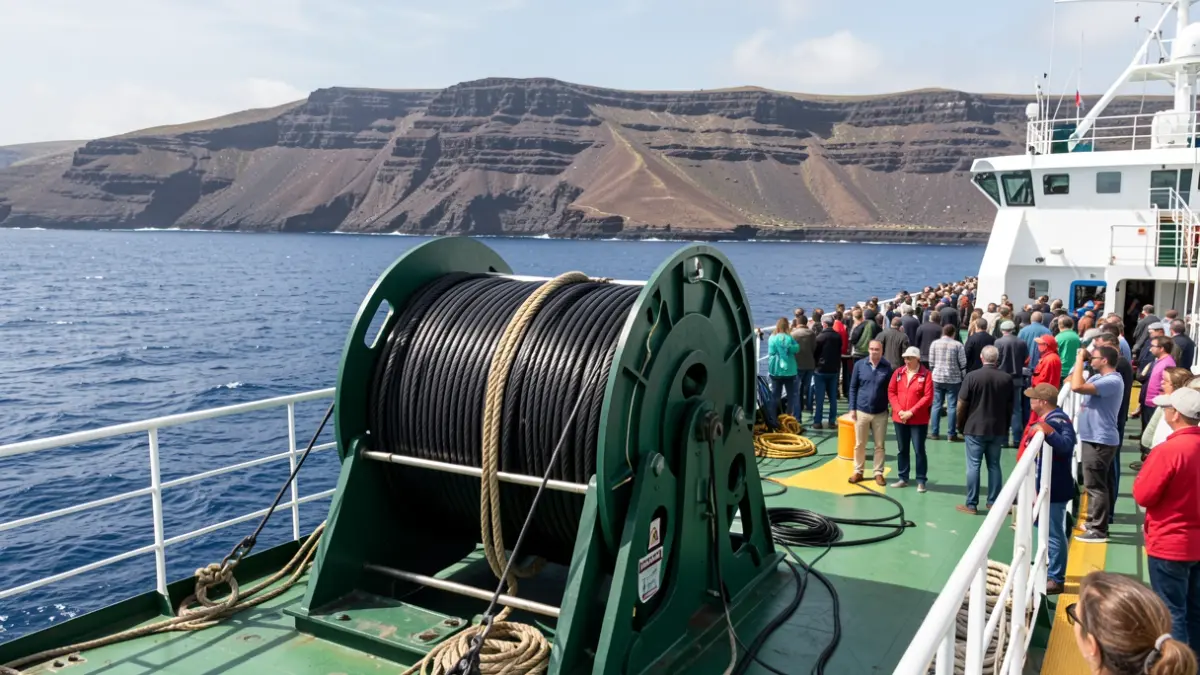
The operation marks a milestone in the development of the RING Project, a new fiber optic network designed to connect Gran Canaria, Lanzarote, and Fuerteventura. This infrastructure, co-financed by the European Union through the CEF Digital program, will extend 553 kilometers of submarine cable to enhance communication capacity and resilience in the archipelago.
The total investment amounts to 34 million euros, with 23 million provided by the European Union. The work is being carried out under strict environmental protection criteria, minimizing impact on the surroundings during all deployment phases.
The system will consist of two independent submarine cables. The eastern cable will connect Ojos de Garza (Gran Canaria) with Puerto del Rosario (Fuerteventura) and Playa Honda (Lanzarote). The western cable will link Barranco de Tenoya (Gran Canaria) with Corralejo (Fuerteventura) and Playa Blanca (Lanzarote). This dual-route configuration will ensure service continuity and offer a more robust infrastructure for operators, businesses, and public administrations.
Rubén Molowny, CEO of Canalink, highlighted that the cable landing in Gran Canaria represents a significant advancement in equipping the eastern islands with a communications infrastructure prepared for future digital needs. He emphasized the importance of connectivity for economic competitiveness and territorial cohesion, fostering innovation and the development of advanced digital services.
This infrastructure of greater capacity and resilience will expand possibilities for developing digital services in areas such as e-government, education, healthcare, the business sector, and tourism.
The RING Project aligns with Canalink's strategy to strengthen the archipelago's digital connectivity infrastructure, with the support of the European Union. It complements other initiatives by the entity, such as the submarine link with Morocco and the new cable between Tenerife and El Hierro.