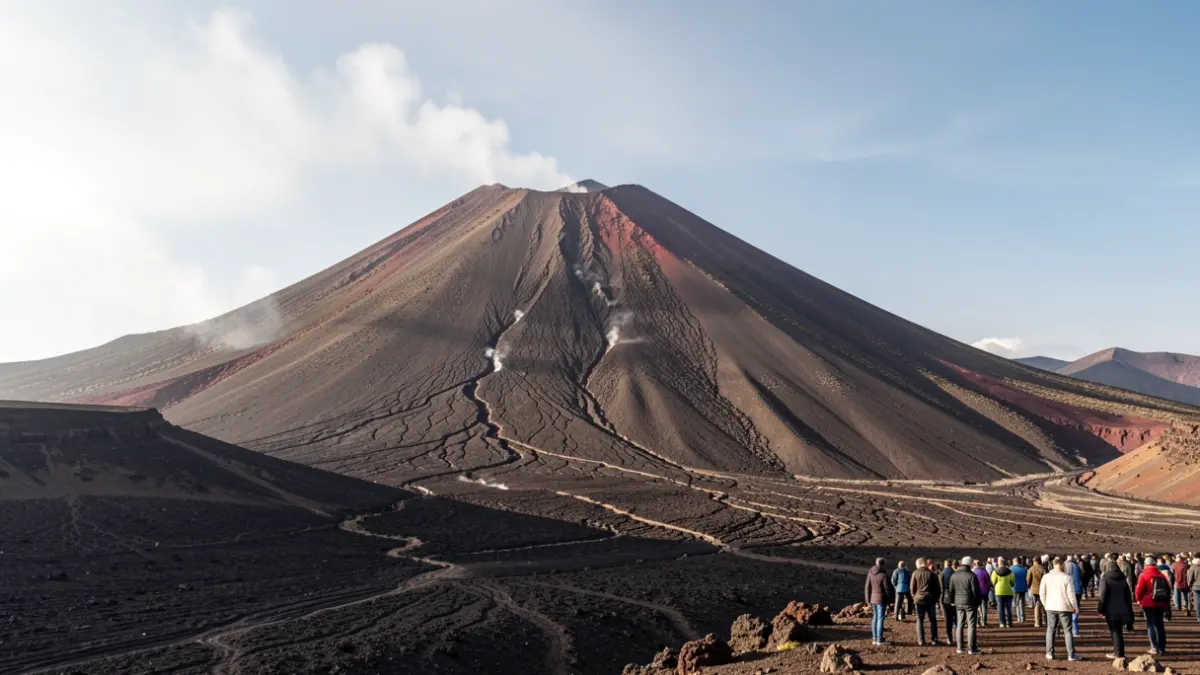
The scientific advisory committee of the Special Plan for Civil Protection and Emergency Response for Volcanic Risk in the Canary Islands (Pevolca) has concluded that the increase in seismic-volcanic activity in Tenerife, recorded since last February, could lead to earthquakes felt by the population. Despite this possibility, experts insist there are no indications of an imminent volcanic eruption in the short or medium term.
The committee's spokesperson and director of the National Geographic Institute (IGN) in the Canary Islands, Itahiza Domínguez, explained that while the occurrence of these tremors cannot be ruled out, they are expected to be of low intensity and incapable of causing damage, unless there is a magmatic intrusion. These potential earthquakes, which might be "lightly felt," would likely be located in the vicinity of Las Cañadas del Teide.
The committee believes that current monitoring parameters, including a decreasing gas emission and minimal ground deformation accumulated over three years, do not justify raising the volcanic alert level to orange. Domínguez also dismissed the popular theory that current seismic activity could prevent a larger earthquake, calling it "popular" and scientifically unsupported.
Currently, no seismic events felt by the population are being registered, and the situation would only become concerning if continuously felt earthquakes began to occur, accompanied by other significant changes. Domínguez reminded that volcanology does not allow for exact predictions and that it is crucial to analyze numerous parameters jointly to assess risk.
Experts indicate that the increase in activity, particularly in June and July, represents a reactivation of the anomalous episode that began in February. However, they emphasize that modern instrumental records only cover about two decades, compared to a volcanic system with eruptive cycles measured in centuries. The importance of relying solely on information from official and scientific bodies is reiterated.