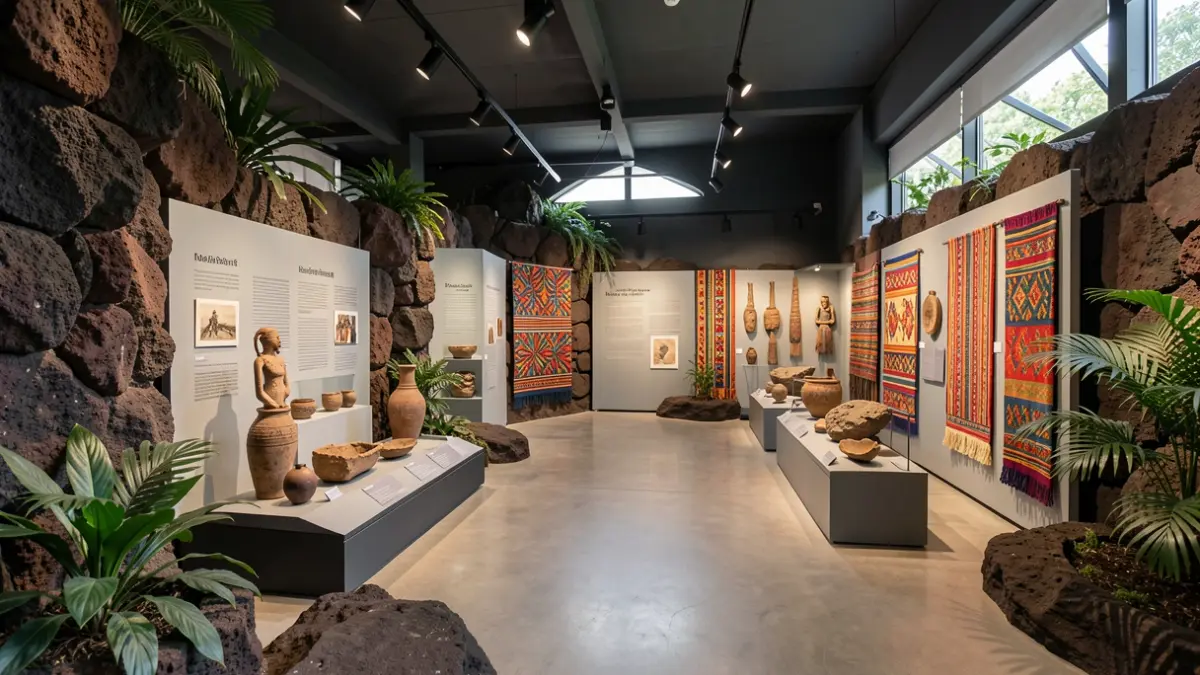
The exhibition offers a journey through the connections, parallels, and historical tensions between the Canary Islands and Mexico, analyzing how two territories separated by the Atlantic have shared cultural and symbolic processes across different stages. It reveals coincidences and links derived from analogous contexts, with special emphasis on the indigenous legacy in the archaeology, popular faith, art, and identities of both territories.
Inspired by the reflections of Fernando Estévez González, the exhibition invites a critical look at how the figures of Mexican and Canarian indigenous peoples were reinterpreted and used as modern identity emblems. "Concomitancias" aims to open cross-border avenues for reflection towards new readings and other identities, underscoring that the indigenous is a matter of the present and the future.
The exhibition is structured into six sections: "Origins", comparing the pre-Columbian cultures of both territories; "European Acculturation and Syncretisms", addressing colonial imposition and religious syncretism, such as the devotions to the Virgin of Guadalupe/Tonantzin and the Virgin of Candelaria/Chaxiraxi; "Trade Routes and Atlantic Revolutions", on the circulation of ideas and goods across the Atlantic and independence processes; "The Return to Origins: Indigenism and Muralism", dialoguing on 20th-century identity strategies in Mexico and the Canary Islands; "The New World Order. The Spanish and European Post-War", analyzing the reconfiguration of both territories after the second half of the 20th century; and "Globalization", on contemporary connections and identity challenges.
In parallel, a narrative "At Foot Level: The Cochineal Trail" traces the history of the nopal cactus and cochineal, an intricate web of relationships between Mexico and the Canary Islands dyed in the intense red of the insect that has historically colored fabrics, economies, and territories through agricultural knowledge, transatlantic exchanges, and landscape transformations.