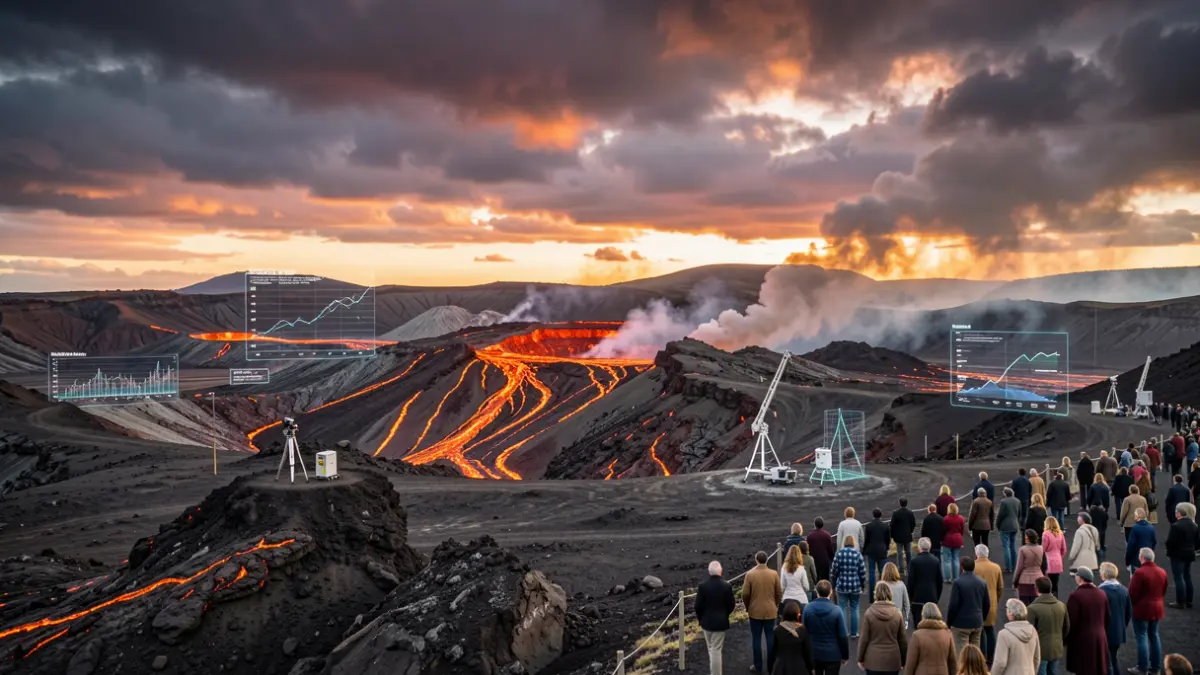
The exhibition about the Tajogaite volcano, titled 'Ash and Lava. Scientific Revelations Next to the Volcano', has begun a new phase in its tour by arriving at the Casa de la Ciencia of the CSIC in Seville, where it will be available to the public until June 2027. This exhibition, which brings the scientific knowledge generated during the La Palma eruption in 2021 closer to the public, is an initiative by Museos de Tenerife in collaboration with the centers of the CSIC in the Canary Islands: the Institute of Natural Products and Agrobiology (IPNA), the Spanish Institute of Oceanography (IEO), and the Geological and Mining Institute of Spain (IGME).
The arrival in Seville represents a significant milestone, being the first time an exhibition conceived by Museos de Tenerife begins its tour on the Peninsula. This event expands the territorial reach of a proposal that originated in the Canary Islands and has allowed the public to see materials, instruments, and research results directly related to the volcanic eruption.
Among the exhibition's highlights are a kaleidoscopic recreation of a volcanic lava tube, a replica of the advanced command post, the impactful sound of the volcano, and various materials expelled during the eruption.
After its initial presentation at the Museum of Science and the Cosmos (MCC) in Tenerife and its subsequent exhibition in La Palma, where it attracted over 115,000 visitors, the initiative takes a new step thanks to the Casa de Ciencia of Seville, the Junta de Andalucía, and the CSIC Delegation in that autonomous community. The project thus transcends the insular scope, bringing to the Peninsula a part of the scientific experience accumulated in the Canary Islands, demonstrating how research developed during a volcanic emergency can also become a tool for understanding, disseminating, and preserving the memory of a transformative event.
The Institute of Natural Products and Agrobiology (IPNA), part of the research center network of the Superior Council of Scientific Research (CSIC) and the State Research Agency, focuses its multidisciplinary activity on areas such as chemistry, agrobiotechnology, volcanology, biodiversity, sociology, anthropology, and atmospheric sciences.