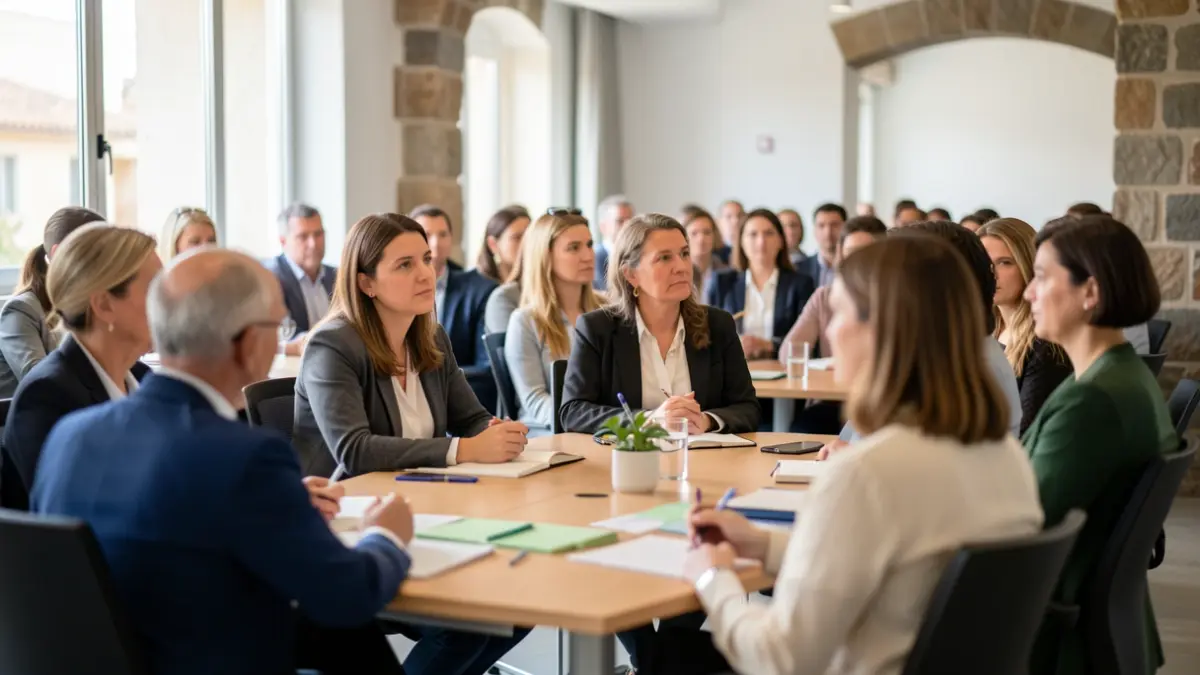
The University of La Laguna held its second workshop, ‘Seeds for the ecosocial transition in Canarias’, on September 21st, as part of the LIDESCAN project. This event follows up on a previous session held in La Palma and aims to validate results and generate specific action proposals for advancing towards a more sustainable development model in the Canary archipelago, in line with the Canary Agenda 2030 and in collaboration with the University of Las Palmas de Gran Canaria (ULPGC).
Both sessions brought together 22 representatives from academia, public administration, social entities, and the productive sector, hailing from 14 organizations across Gran Canaria, La Palma, Fuerteventura, La Gomera, Tenerife, and Lanzarote. The objective was to share knowledge, reflect on obtained results, and identify potential scenarios and lines of action for the 2027-2030 and 2040-2050 timeframes.
The inauguration was attended by José Manuel García Fraga, Vice-Rector for Teaching at ULL; Julio Brito, manager of FGULL; Carlos Fernández, principal investigator of LIDESCAN; and Carmelo León, director of the UNESCO Chair at ULPGC. García Fraga highlighted the importance of co-creation between academic institutions and other entities for knowledge transfer, while Brito emphasized the need for joint alliances in the face of a complex and uncertain world.
Carlos Fernández recalled that the meeting serves to synthesize previous work and move towards concrete proposals. Carmelo León, in turn, highlighted the development of ideas from the first phase to jointly address challenges. The workshop included presentations such as ‘Towards integral governance for a just ecosocial transition’ by Pedro Gil (University of Deusto) and ‘Canarias facing the ecosocial transition: long views for a change of era’ by Matías Manuel González (ULPGC).
Following the presentations, participants reviewed the main content and conclusions of the first workshop through collective reflection, focusing on agroecology, energy, and tourism. The work allowed for the validation and completion of proposals related to different temporal horizons. Future scenarios were proposed, including one with funding and a joint project, and another without economic resources, to identify actions that could be developed at a personal or professional level.
The workshop concluded with a collective prioritization of relevant actions. The outcomes will be compiled into a synthesis document validated by ULL, ULPGC, and participating entities, which will be submitted to the Government of Canarias to contribute to the design of future public policies related to the ecosocial transition.