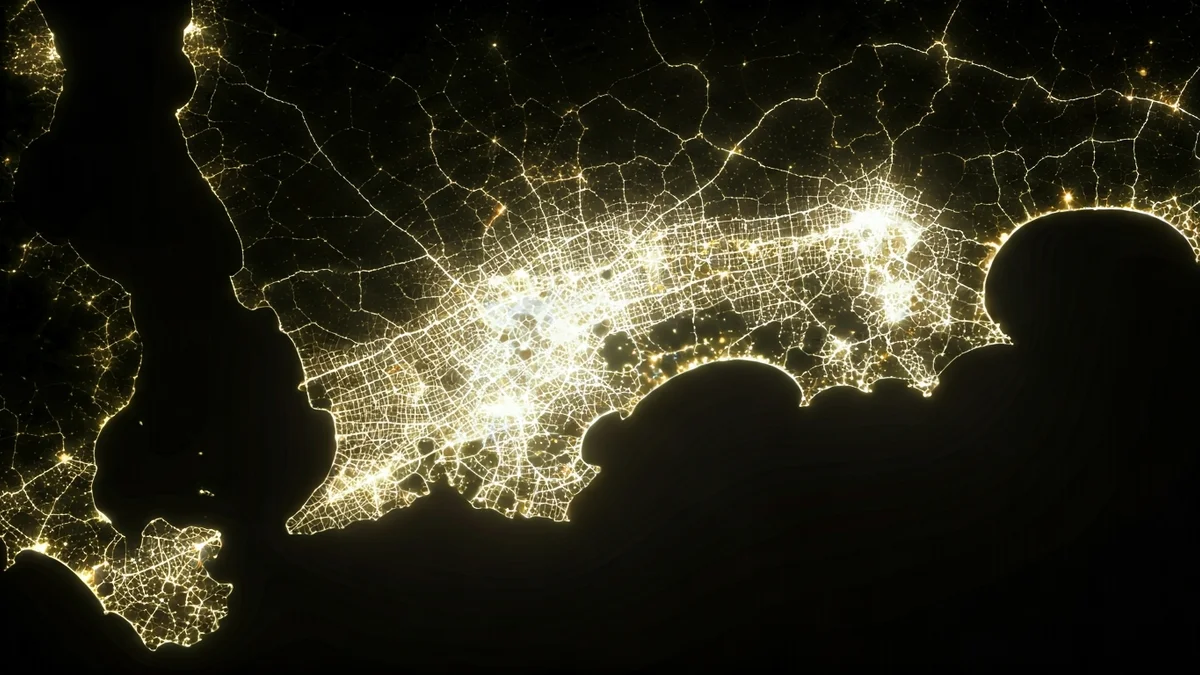
Over 400 kilometers above the Atlantic, Expedition 74 flight engineer Chris Williams used a Nikon Z9 camera with a 200mm telephoto lens to photograph the night sky over Tenerife and Gran Canaria. These images, recently taken during his mission aboard the ISS, have become a crucial scientific and journalistic document, confirming a serious problem of "light pollution" in the islands.
“"We have too much of that light."
According to Antonia Varela, president of the Starlight Foundation and researcher at the Institute of Astrophysics of the Canary Islands (IAC), the scientific explanation for this visibility from space is the "upper hemispheric flux." This phenomenon describes the luminous energy emitted directly upwards or reflected, escaping into the atmosphere. Varela explains that "everything seen in color gives us an idea that it is wasted light."
In certified Starlight zones, such as the Teide National Park in Tenerife or the Gran Canaria Biosphere Reserve, the percentage of wasted light should be zero or minimal. However, Williams' photographs show that in the urban and tourist areas of both capital islands, this percentage is significantly higher. Varela emphasizes that "even visitors would appreciate having sun and beach by day and darkness at night to see the stars."
Although nocturnal satellites exist to document the island's reality, Williams' images are unique because they offer a natural color perspective, something that low-light sensors do not provide. NASA highlights that the ISS orbits Earth every 90 minutes, allowing the crew to observe 16 sunrises and sunsets daily, which facilitates an understanding of the terrestrial night that is difficult to obtain from the ground.
The difference in luminosity between Gran Canaria and Tenerife in the photographs is attributed to the type of LED lighting installed. Luminaires with high color temperature LEDs, known as "cold LEDs" with a white-blue spectrum, disperse with greater intensity in the atmosphere. Varela compares "blue LEDs" to "putting suns at night," as their light disperses more due to atmospheric properties, magnifying light pollution.
Reducing photopollution does not mean turning off cities, but rather illuminating efficiently. Varela proposes "properly illuminating what needs to be illuminated" through remote management, adequate shielding, good intensity, and reducing light at night when pedestrian traffic decreases.