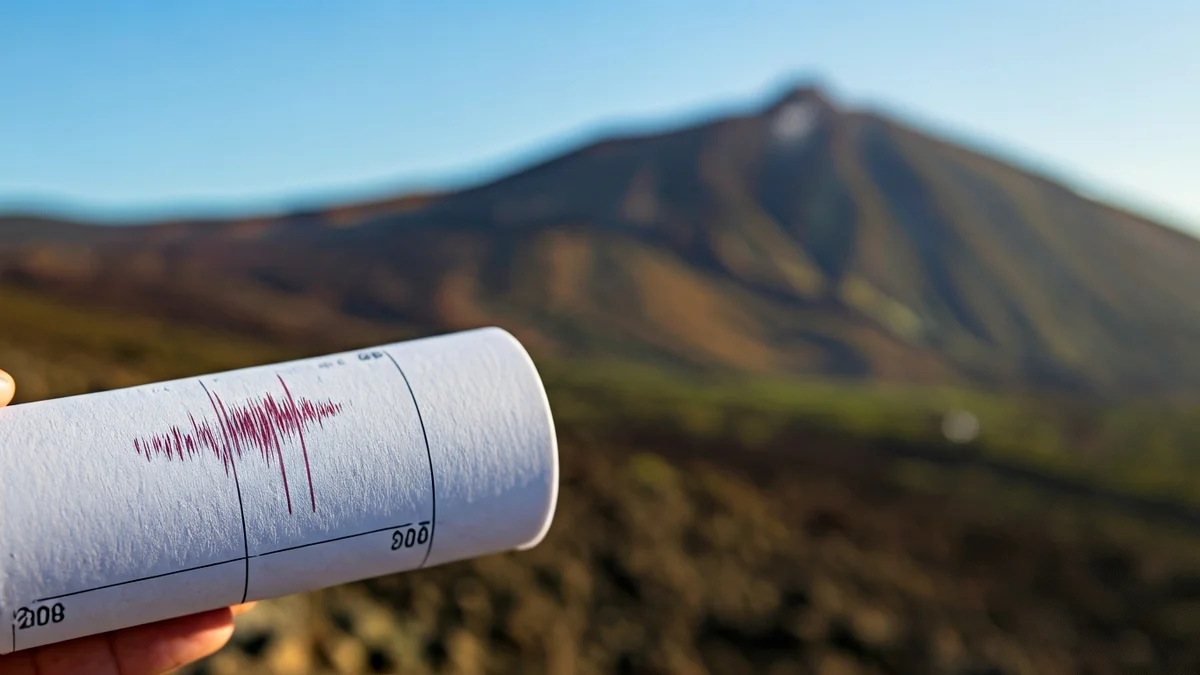
Volcanic surveillance in the Canary Islands has once again focused on the heart of Tenerife. The National Geographic Institute (IGN) has reported a new episode of seismic activity in the Las Cañadas del Teide area, with a total of 131 hybrid events counted since April 3. These micro-earthquakes are characterized by small energy pulses and low-frequency signals, leading scientists to conduct exhaustive monitoring.
Despite the number of events, the institution has issued a reassuring message to the public. Preliminary analyses indicate that the tremors recorded over the past 72 hours do not increase the volcanic risk on the island in the short or medium term.
Of the 131 events, the IGN technical team has manually located 31. Their magnitudes range between 0.4 and 1.6 mbLg, very low energy levels that make them imperceptible to humans. The IGN has confirmed that none of these recent events have been felt by the population.
The epicenters are located beneath Las Cañadas, at depths varying between 5 and 18 kilometers. The first tremor in this series was recorded on April 3 at 10:47 PM, and activity has been intermittent since then. Experts highlight a fundamental difference from previous episodes, such as those in February: this activity does not show a repetitive pattern of “seismic swarms” but rather isolated pulses and long-period signals (LP events).
This type of hybrid seismicity, although requiring close monitoring, does not indicate that an eruption is imminent.
The possibility of volcanic reactivation is a recurring concern among Tenerife residents. However, the IGN has been unequivocal: the current hybrid seismicity, while closely monitored, does not suggest an imminent eruption. Tenerife boasts one of the most advanced monitoring networks in the world, with over 100 stations and measurement equipment that monitor in real-time any changes in seismicity, ground deformation, or volcanic gas geochemistry. This infrastructure ensures the immediate detection and communication of any anomaly indicating a real volcanic danger.
Due to the low amplitude of the signals, the IGN has noted that current data are provisional. The analysis of micro-earthquakes is complex and requires detailed filtering of low-frequency signals. Therefore, experts anticipate that the total number of detected events could increase as the study of seismic station recordings progresses. This type of hybrid seismicity is common in active volcanic systems and is usually related to the movement of fluids (water, gas, or magma) at great depths, without necessarily leading to a surface eruptive process. Monitoring remains at its highest level, within the normal geological activity of a volcanic island like Tenerife.