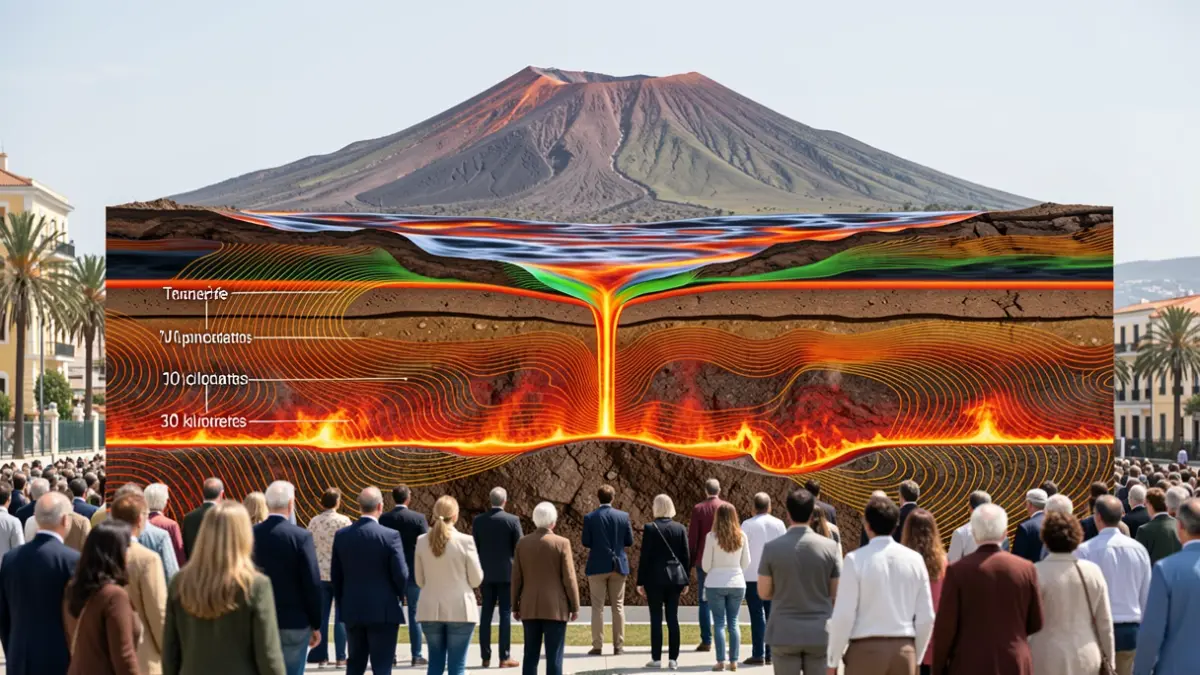
The research, led by Víctor Ortega Ramos, a doctoral student at the Complutense University of Madrid (UCM) and researcher at Involcan, has for the first time obtained a three-dimensional image of Tenerife's crust and upper mantle. The findings have been published in the journal Scientific Reports, part of the Nature group.
The study identifies an oceanic crust approximately 10 kilometers thick. Beneath this, scientists have located four major low-seismic-velocity anomalies, situated between 10 and 30 kilometers deep. These zones are interpreted as areas of high temperature and potential changes in rock composition, suggesting the presence and accumulation of magma originating from the upper mantle.
The most significant finding is concentrated beneath the west of the island, where exceptionally low S-wave seismic velocities were recorded. Thermodynamic modeling of this data suggests that this area could contain a significant proportion of molten material, related to magmatic underplating processes where mantle magma accumulates at the base of the crust.
To reconstruct this deep structure, over 785 teleseisms (large-magnitude earthquakes recorded globally) between 2017 and 2024 by the Canary Seismic Network on the island were analyzed.
Furthermore, a spatial correlation has been observed between these deep anomalies and some of the recent seismic activity in Tenerife. A significant portion of the earthquakes are located above or at the edges of the main low-velocity zone, which could be linked to magma accumulation and transfer, as well as the migration of magmatic gases and fluids.
Involcan anticipates that future research will focus on detailing the geometry, extent, and connectivity of these deep zones, which could help explain some of the seismicity and degassing observed in Tenerife. The project involved collaboration from Involcan, the UCM, the Institute of Technology and Renewable Energies (ITER), the University of Geneva, and the Institute of Research in Vulcanology and Risk Assessment of Portugal, and was funded by the TFvolcano project of the Cabildo of Tenerife.