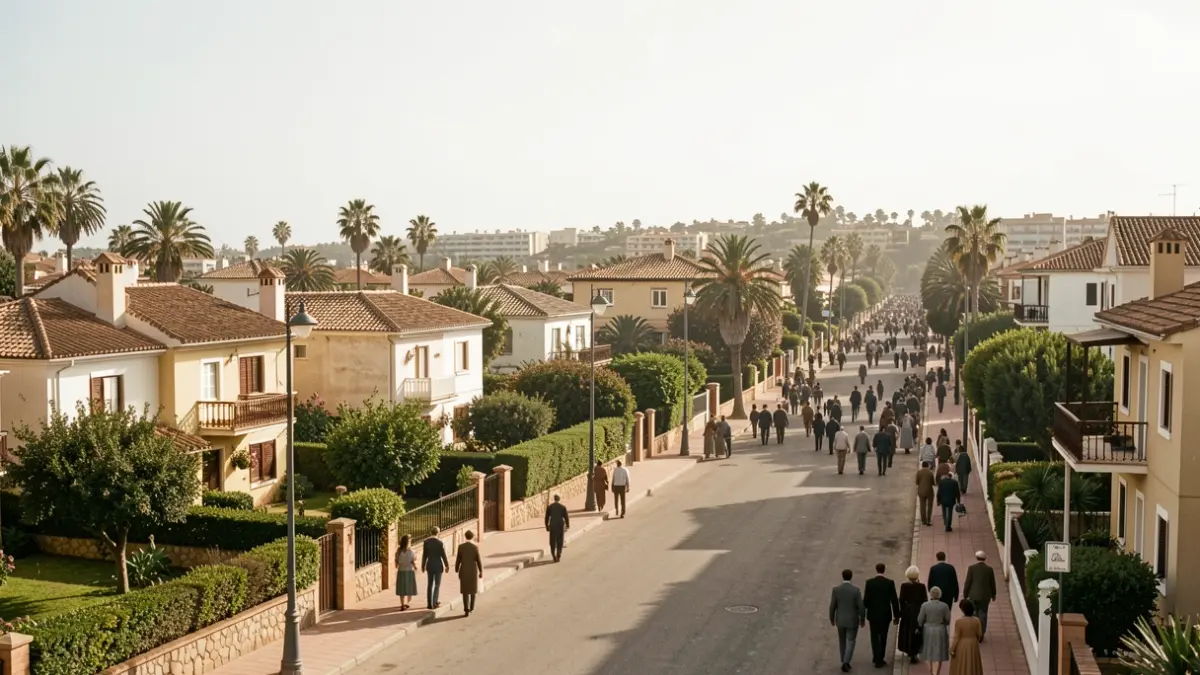
What we now know as Ciudad Jardín, one of the most desired neighborhoods in Las Palmas de Gran Canaria, has humble origins. Before becoming an area of villas and quiet streets, the zone was the old Vega de Santa Catalina, a landscape of little-valued sandbanks that was even an inconvenience for the commercial development of the time in the late 19th century.
This space, far from the residential aspirations of the local bourgeoisie, contrasted with the vision of urban growth driven by economic activity and trade. British presence on the island played a crucial role in its transformation, introducing an urban planning model that sought to combine housing, green spaces, and a certain distance from the city center.
The name 'Ciudad Jardín' (Garden City) does not refer to the abundance of pre-existing gardens, but directly relates to the garden cities concept popularized in Europe in the late 19th and early 20th centuries. The idea, promoted by Ebenezer Howard, proposed a balance between urban and rural life.
British influence materialized in the construction of villas and facilities, shaping the area as the "hotel district," with the Hotel Santa Catalina as one of its landmarks. This occupation of the territory, with detached houses and large plots, represented a different residential alternative to the historical centers like Vegueta or Triana.
Although the Gran Canaria version was not an exact replica of Howard's theoretical model, it did adapt the idea to an exclusive residential area. The name, therefore, did not describe the existing reality, but the aspiration of what was intended to be created.
Formal urban development arrived with the Urban Planning Plan for Las Palmas presented by architect Miguel Martín-Fernández de la Torre in 1922. This plan reorganized the old Vega de Santa Catalina, and Martín-Fernández de la Torre himself helped shape the neighborhood by designing numerous homes. The proposal attracted the affluent classes seeking privacy and tranquility.
Approved in 1930, the plan set the course for the following decades, seeing the area progressively fill with villas. By the mid-20th century, Ciudad Jardín was already recognizable, occupying the space that had historically separated the old town from the port, contributing to the city's unification.