A team from the High Inspection of the Directorate General of Culture and Cultural Heritage of the Government of the Canary Islands will visit the hermitage to assess the condition of the murals. This visit responds to a request from the Cabildo of Gran Canaria, which asks for the possibility of initiating a sanctioning procedure against the Las Palmas de Gran Canaria City Council. The reason is the alleged commission of a serious infringement of the Law on Cultural Heritage of the Canary Islands, resulting from severe damage to heritage due to a possible omission of the duty of conservation.
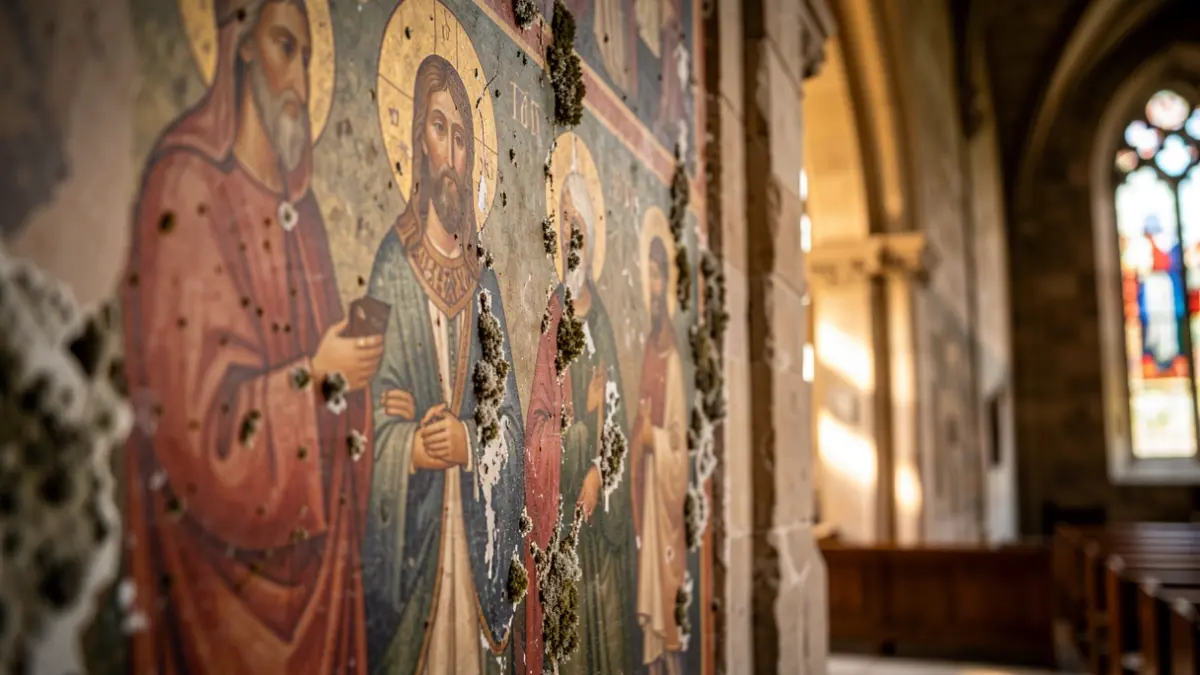
The murals, created by the Gran Canarian painter Jesús Arencibia using the encaustic technique on canvases adhered to the wall, depict the martyrdom and glory of Saint Catherine of Alexandria. The work was previously covered with commercial signage when the hermitage was used as a souvenir shop between the 60s and 70s. After its recovery for public use under the mayorship of Juan Rodríguez Doreste, the murals were restored to their original state.
Currently, the deterioration is mainly attributed to water leaks from the roof, which have caused salts and the proliferation of fungi, affecting the pictorial layer, its color, and its adhesion to the wall. Since July 2025, technicians from the Historical Heritage of the Cabildo of Gran Canaria have been raising alarms about damage they consider irreversible in some areas, estimating that 2% of the canvas surface suffers irreparable harm.
Island specialists complained from January 2026 onwards that the Las Palmas de Gran Canaria City Council had not fulfilled its obligations to present an architectural project to stop the humidity, change the air conditioning system, or develop an action plan. This led to the sanction request by the Cabildo, a proposal with which the capital's council disagrees, announcing the drafting of a response report to justify its maintenance and conservation actions.
“"Technicians have been warning about the damage to the murals since last year, and now we see that nothing has been done yet."
Pepa Luzardo, Councillor of the Popular Party on the Cabildo of Gran Canaria, lamented the irreversible deterioration of the murals, also pointing out the responsibility of the Cabildo. She announced an interpellation to the Minister of Presidency, Teodoro Sosa, regarding the situation. Luzardo believes the Cabildo has been negligent and urges the Government of the Canary Islands to act ex officio, criticizing the lack of action despite technical warnings since last year.
It is recalled that in 2019, before the restoration of the hermitage, it was decided to protect the paintings with packaging and insulation materials, following instructions from the Cabildo's specialists, as reported at the time by the Las Palmas de Gran Canaria City Council.
Furthermore, the spokesperson for Coalición Canaria (CC) in the Las Palmas de Gran Canaria City Council, David Suárez, requested the urgent recovery of the mural by artist Juan Guerra Hernández in Plaza de El Secadero II, a work from the 80s. He stated that the mural is a symbol of identity for the neighborhood and that its surroundings, including the square, show deterioration and are cordoned off due to falling debris, urging for it to be declared a Site of Cultural Interest (BIC).