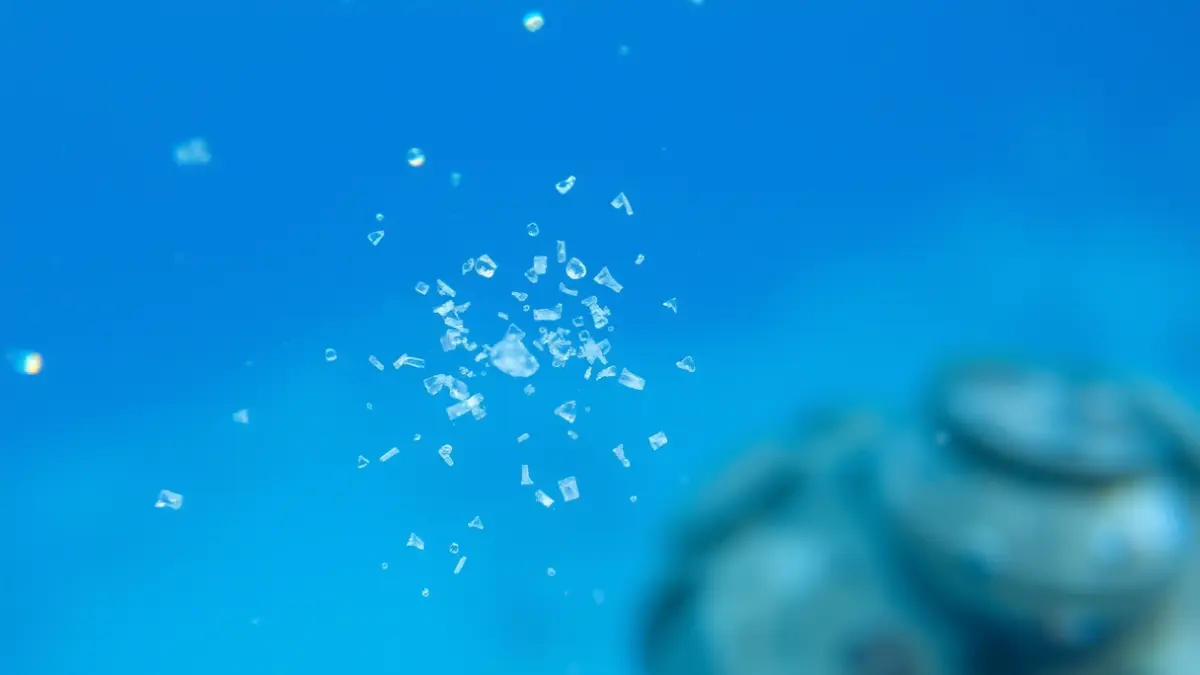
The research, published in the scientific journal Marine Pollution Bulletin, offers new insights into how these tiny particles behave in the ocean, challenging previous ideas about their distribution.
“"We found low-density microplastics, which should float, at any depth, even over a thousand meters. Being so small, less than 200 microns, buoyancy ceases to be a determining factor."
The work highlights two main conclusions: the existence of microplastics in remote and deep ocean areas, and their prolonged persistence in the marine environment. These fragments, many below 200 microns, can travel great distances and undergo chemical transformations over time. The high oxidation of these compounds suggests they have remained in the ocean for a long period, subjected to degradation processes.
Sample collection was carried out during oceanographic campaigns aboard the vessel Ángeles Alvariño, in collaboration with the Spanish Institute of Oceanography and the University of La Laguna. For each sample, more than 50 liters of water were filtered at different depths.
Contrary to the belief that microplastics concentrate on the surface, the study reveals a more complex distribution, with concentration peaks at about 150 meters and around 1,100 meters. Accumulation at 150 meters occurs at the end of the surface mixed layer, while at 1,100 meters, the arrival of more contaminated water masses from the Mediterranean plays a role.
A notable finding is the presence of 'floating' plastics like polyethylene or polypropylene at great depths, indicating that distribution does not solely depend on material density, but also on factors such as currents, ocean eddies, and degradation. The study also detected a constant presence of microscopic fibers, originating from clothing or fishing nets, throughout the water column, with concentrations ranging from 1 to 6 fibers per liter.
At greater depths, a more advanced degree of degradation was observed in some materials, making their identification difficult. This process reinforces the idea that microplastics persist in the ocean, chemically transforming and remaining in suspension at various depths, rather than settling on the seabed.
The results confirm that microplastic pollution is a global phenomenon, influenced by ocean currents such as the North Atlantic subtropical gyre and the arrival of water masses from other regions. Even in areas far from the Canarian coast, these particles are present, underscoring that microplastics have colonized virtually the entire ocean, even its most invisible parts.