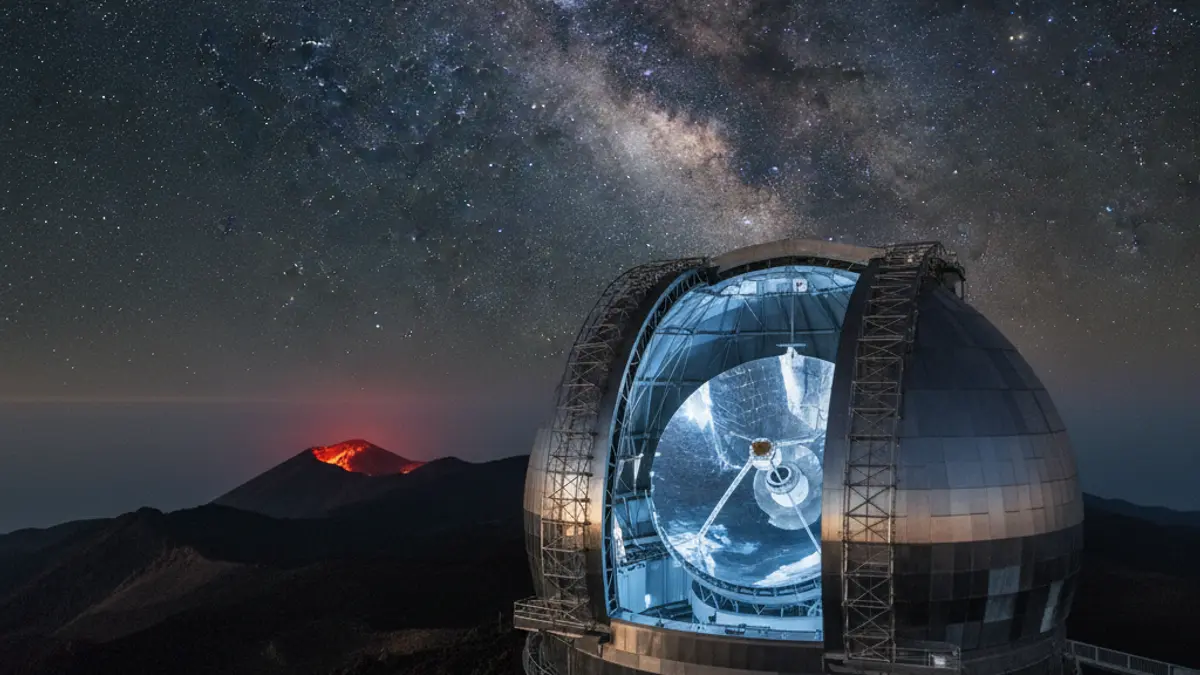
This initiative, which has evolved over a decade of scientific cooperation, aims for China's formal integration as an international partner of the GTC. The director of the GTC, Romano Corradi, highlighted the excellent relationship between both institutions, even recalling a visit by the President of the Government, Pedro Sánchez, to a telescope exhibit during his official trip to China.
The Chinese Academy of Sciences' interest lies in joining the GTC in a similar way to Mexico and the University of Florida. To achieve this, the Chinese organization is developing a complex scientific instrument, valued at over 20 million euros, which will be installed in the telescope upon completion.
“"The relationship between both institutions is magnificent."
While this incorporation is being formalized, Chinese researchers already have access to observation time on the telescope and maintain significant scientific output based on data obtained from the observatory, located in Roque de Los Muchachos.
The new optical instrument will be specifically designed for the search and characterization of planets similar in size to Earth, located in habitable zones around Sun-like stars. While detecting large gaseous planets is relatively straightforward, identifying Earth-like worlds requires much higher precision.
Currently, only one instrument with comparable capabilities is installed in the VLT telescope in Chile. Therefore, the device planned for the GTC would be the first of its kind in the northern hemisphere. The project is divided into two phases, with the first part expected to be delivered between 2027 and 2028, and the second between 2029 and 2030.