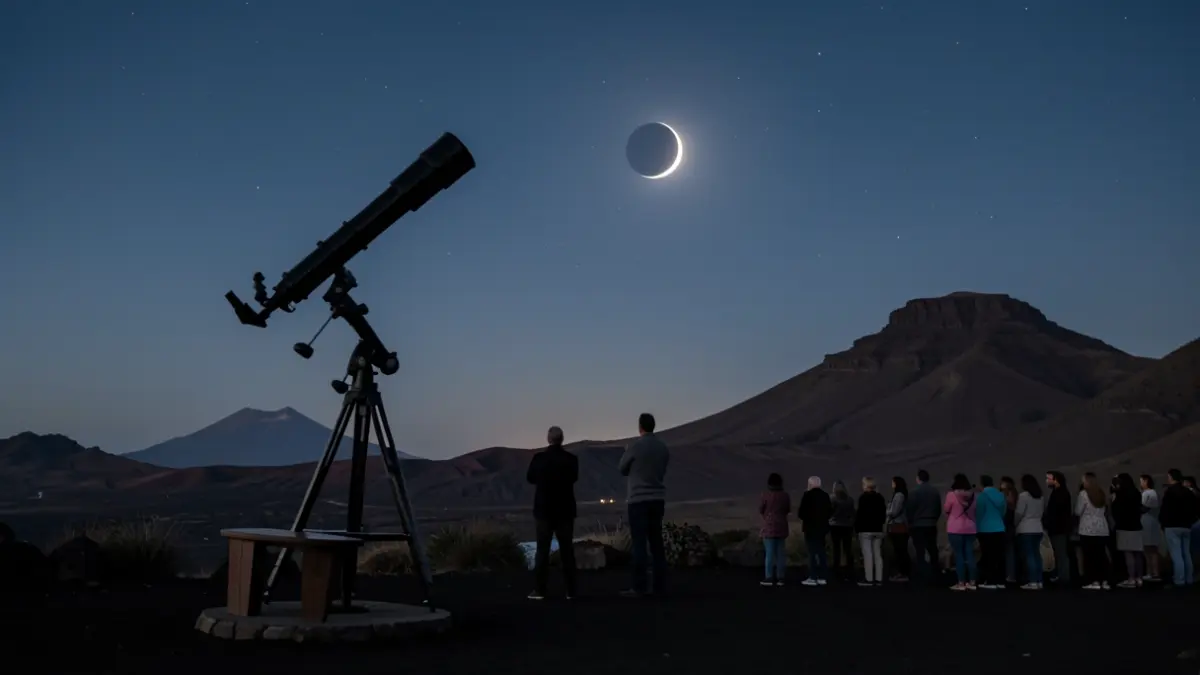
Jessica de León, Minister of Tourism and Employment for the Canary Islands Government, presented the special 'Atalayas' initiative, driven by the Elder Museum of Science and Technology. The aim is to allow residents and visitors to safely enjoy the phenomenon while learning about its causes and the exceptional conditions of the archipelago's skies for astronomical observation.
De León highlighted that this cycle of eclipses positions the Canary Islands as an international benchmark in astronomy. She noted that while the eclipse will be visible throughout the archipelago, the eight 'Cosmic Watchtowers', led by the Elder Museum in collaboration with the Ministry of Science, Innovation and Universities and other science museums, will provide guaranteed observation points.
Emphasis was placed on safety, with the distribution of certified glasses and recommendations for responsible viewing. José Gilberto Moreno, General Manager of the Elder Museum, added that the maximum solar obscuration in the Canary Islands will reach 77%, calling it an exceptional opportunity. The museum aims for the experience to be understandable and safe for everyone.
The ONCE, through its delegate in the Canary Islands, José Antonio López, underscored the collaboration to ensure that blind and visually impaired individuals can also follow the eclipse. A device will transform light into sound, making science accessible. López reiterated the importance of certified glasses and safety measures.
Observation points will be set up in Caleta de Sebo (La Graciosa), La Santa (Lanzarote), El Cotillo (Fuerteventura), Tejeda (Gran Canaria), Playa San Juan (Tenerife), Valle Gran Rey (La Gomera), La Frontera (El Hierro), and Tazacorte (La Palma). Science communicators will accompany the public, explaining the eclipse phases and answering questions.
The distribution of certified glasses has already begun at the Elder Museum in Las Palmas de Gran Canaria and will continue at the designated observation points.