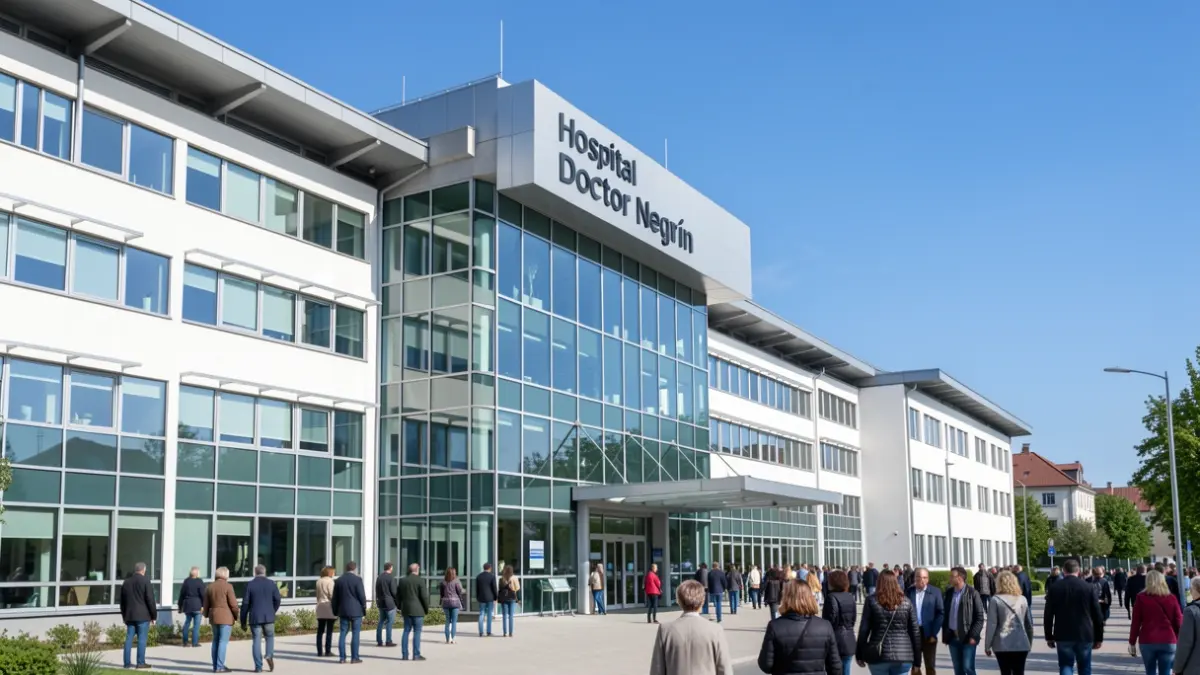
The advanced therapies building at Doctor Negrín Hospital, in Las Palmas de Gran Canaria, has begun construction with the laying of its first stone. This infrastructure, projected to be completed within two years, represents a significant advancement for cancer diagnosis and treatment in the region.
The Canary Islands' Minister of Health, Esther Monzón, emphasized that the new facility signifies "a great leap forward, not only for diagnosis but also for cancer treatment." The building will be located in the southwest corner of the hospital complex, adjacent to Doctor Alfonso Chiscano Díaz street, and will span 4,300 square meters across five floors, two of which will be underground. These will house the core of the project: the bunkers for the cyclotron and the proton therapy equipment, a high-precision technology for treating specific types of cancer.
The ceremony was attended by the President of the Government of the Canary Islands, Fernando Clavijo; the Director of the Canary Health Service (SCS), Adasat Goya; the manager of Doctor Negrín Hospital, Miguel Ángel Ponce; and the project's technical director, Antonio Ocaña. Beneath the first stone, a time capsule was buried containing commemorative items, including the front page of CANARIAS7 announcing Spain's football World Cup victory.
Esther Monzón described the day as "historic" for the Canary Islands, noting that it will be the only center in Spain to have both proton therapy and an independent cyclotron for Nuclear Medicine within the same building. The cyclotron will enable the Canary Islands to produce its own radioisotopes for diagnostics, reducing reliance on mainland supplies and streamlining tests like PET scans, which have short half-lives and require constant delivery.
President Fernando Clavijo recalled that the project has a budget of 20.5 million euros and is the result of the Canary Executive's commitment to placing the patient at the "center of the system." He also highlighted the public-private collaboration, particularly the contribution from the Amancio Ortega Foundation for the proton therapy unit, emphasizing the importance of private investment for social benefit.
Currently, Spanish public healthcare lacks proton therapy equipment, with only two units available in the private sector, limiting patient access. Proton therapy uses protons instead of X-rays or electrons, allowing for more localized radiation delivery and minimizing damage to healthy tissues, which is especially significant for patients with long-term survival prospects, particularly children.
Clavijo assured that the regional government will monitor the construction progress to ensure it stays on schedule and praised the work of the Doctor Negrín team, stating that while infrastructure is important, it is the healthcare professionals who provide the service and heal people.