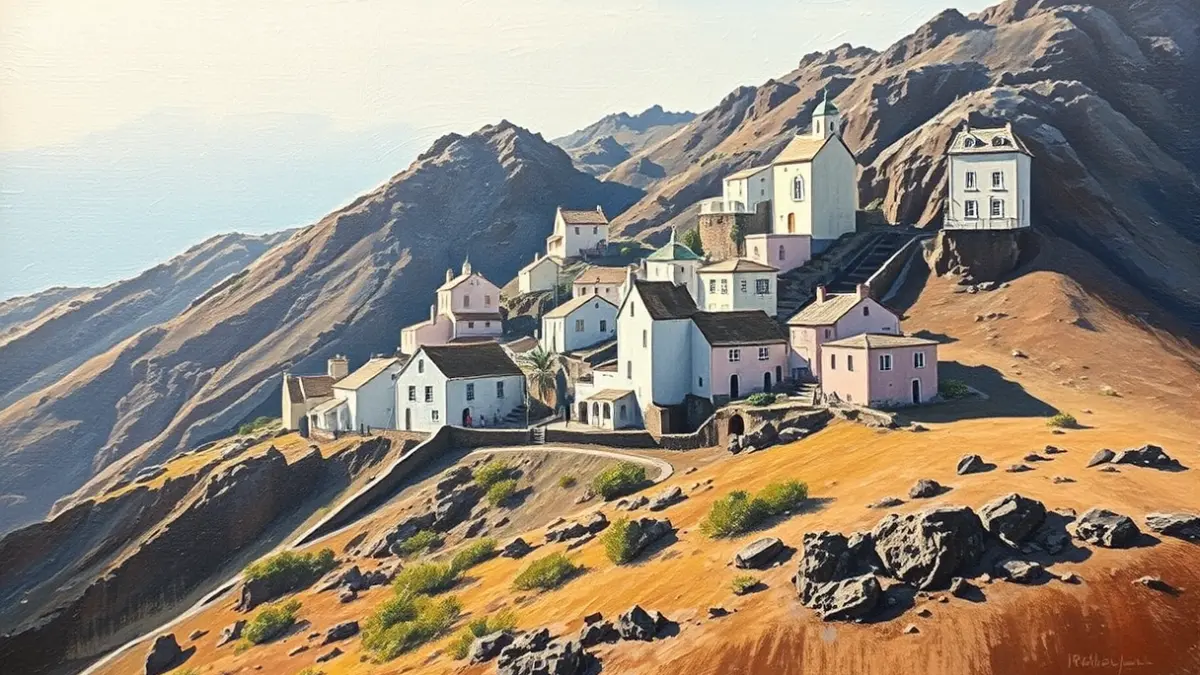
Literary critic Lázaro Santana has analyzed this work, which adds to the known body of the painter's work. The piece depicts the Risco de San Nicolás, a motif that Massieu explored on numerous occasions throughout his career, capturing its different shades and lights at various times of day.
Massieu's fascination with this urban landscape was already highlighted in 1926 by the traveler Felipe Sassone, who, during his stay at the Hotel Santa Catalina in Las Palmas de Gran Canaria, was impressed by the artist's mastery in portraying the cliffside in multiple paintings. Sassone described Massieu as a “landscape artist who knows how to draw and an ultrasensitive colorist”.
“"Massieu is a fine artist: a landscape painter who knows how to draw, and an ultrasensitive colorist, who feels the emotion of the landscape."
Despite Massieu's prolific output, with an estimated more than 400 works, many of them remain unknown or little studied. This new discovery, although not part of the original series seen by Sassone in 1926, is significant. The painting, measuring 65 x 60 cm, is signed and dated 1929, and is characterized by an almost monochrome composition in blue, yellow, and white tones, suggesting the capture of a sunrise.
The technique employed by Massieu in this work is notable, with short, incisive spatula strokes that create a rough pictorial surface, making the house facades display a coarse texture, like unflattened whitewash. Unlike other known cliffside paintings by the artist, this version omits the usual wooded base, showing only three palm trees on the right edge of the composition.
The Risco de San Nicolás, with its vibrant colored houses built on the hillside, represented for Massieu not only an aesthetic motif but also a reflection of life in Las Palmas de Gran Canaria. Although art transforms reality, Massieu's work manages to capture the inherent beauty in a landscape that, for the 19th-century tourist, was an “exotic motif” that concealed the reality of poverty.