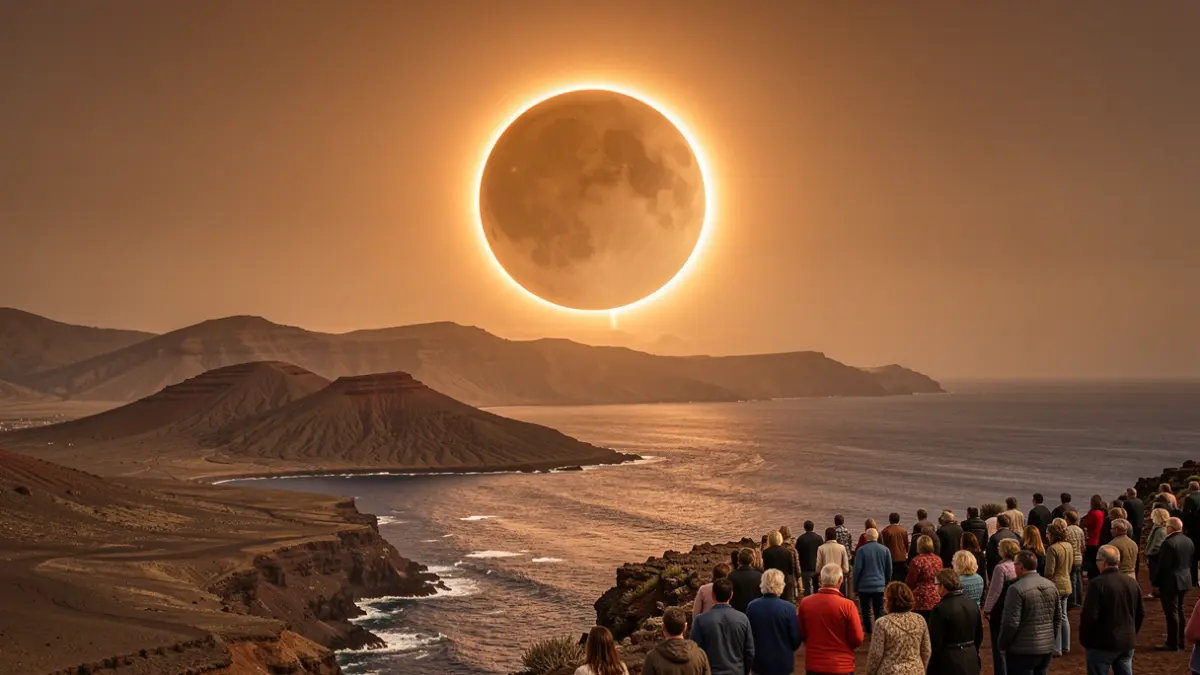
This Wednesday, the Canary Islands' population will be able to enjoy a partial solar eclipse, an astronomical event that promises to be a memorable experience. Unlike other parts of the mainland where it will be total, on the islands the Moon will cover up to 77% of the solar disk.
The president of the Canary Society of Ophthalmology, Rodrigo Abreu, emphasizes the importance of safety: "It can only be observed safely with certified and approved glasses; there are no alternatives." The use of adequate eye protection is essential to prevent irreversible vision damage, such as vision loss, alterations in color perception, or distortion of shapes.
Given the forecast of mass travel to the mountains and the risk of fires in sensitive areas due to high summer temperatures, the Canary Islands government will activate the pre-alert status of the Territorial Emergency Plan for Civil Protection of the Autonomous Community of the Canary Islands (Plateca). The Civil Guard will deploy a special land, sea, and air operation to ensure safety and traffic flow.
Authorities recommend observing the eclipse from nearby and accessible locations such as terraces, rooftops, squares, beaches, or viewpoints, avoiding travel to forest areas. The phenomenon will begin around seven in the evening and end shortly before a quarter to nine at night, reaching its peak around five to eight, when the Sun will take on the shape of a thin golden croissant.
The Elder Museum has set up observation points on all eight islands, the so-called "cosmic watchtowers," operational from 6:30 PM to 9:30 PM. At these points, eclipse glasses will be distributed free of charge, and information about the phenomenon will be provided. In the province of Las Palmas, these points will be located in Caleta de Sebo (La Graciosa), La Santa (Tinajo, Lanzarote), Poblado de Atalayita (Antigua, Fuerteventura), and Tejeda (Gran Canaria). In the western province, they will be in Playa de San Juan (Tenerife), Valle Gran Rey (La Gomera), Tazacorte (La Palma), and La Frontera (El Hierro).
Due to geographical positioning, the start and peak of the eclipse will vary slightly between islands. It will begin earlier in La Graciosa and Lanzarote (7:04 PM), followed by Fuerteventura and La Palma (7:05 PM), and later Gran Canaria, Tenerife, and La Gomera (7:06 PM). El Hierro will be the last to start the event (7:07 PM).
Ophthalmologist Ricardo Abreu warns about the irreversible consequences of looking at the Sun without protection, such as vision loss, alterations in color perception, or distorted shapes. He recommends not looking at the sun for more than 30 seconds at a time, with ten-minute breaks between observations, and paying special attention to children. He suggests following the phenomenon through the media if approved glasses are not available.