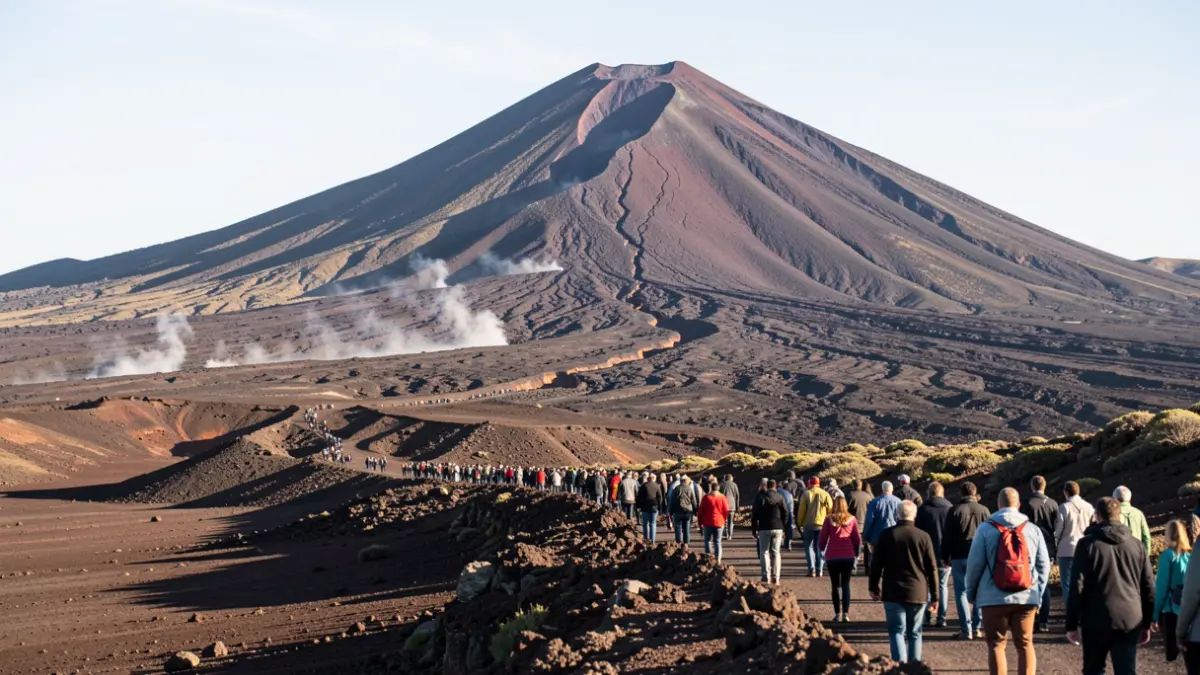
Following a brief period of calm, the subsoil of Tenerife has once again shown signs of activity. The National Geographic Institute (IGN) has detected around a hundred seismic events on the island within the last 24 hours, most of them located west of Las Cañadas del Teide. This new phase of activity began in the early hours of last Thursday, June 25th.
According to an official statement from the IGN in the Canary Islands, several pulses of volcano-seismic activity have been registered since midnight on June 25th. One of the most notable events occurred at 3:54 AM, and the seismic sequence remained active at the time the official note was issued.
Provisional data indicate that 107 seismic events have been counted, of which 24 have been located by the volcanic seismology group of the Canary Islands. The epicenters are primarily concentrated in the municipalities of Guía de Isora and Vilaflor de Chasna, at depths ranging between 10 and 16 kilometers below sea level. The maximum magnitude recorded so far has been 2.0 mbLg, with none of these movements being perceived by the population.
The IGN explains that this episode has included different types of seismic signals, such as volcano-tectonic earthquakes, low-frequency events, and hybrid events, which are the predominant ones in this process. In addition to the usual area of seismic swarms associated with the central volcanic system of Tenerife, small, very low-magnitude earthquakes have also been detected in other areas of the island, specifically in Fasnia and near Teide.
Despite this increase in activity, the body responsible for volcanic monitoring in Spain emphasizes that the current situation does not increase the probability of an eruption in the short or medium term. Experts consider these movements compatible with the circulation or interaction of magmatic fluids at depth, a phenomenon that has been recurrently observed since the beginning of the year.
The IGN's statement notes that the persistence of activity in the same region is compatible with the presence of an active localized process. However, they stress that this type of seismicity, analyzed in isolation, does not necessarily indicate an evolution towards eruptive scenarios.
Finally, the IGN reminds that it maintains a network of over 100 stations and sensors deployed in Tenerife to monitor seismic activity, ground deformation, and geochemical parameters in real-time. They warn that the disseminated data are provisional, and the final number of detected earthquakes could increase after detailed analyses are completed.