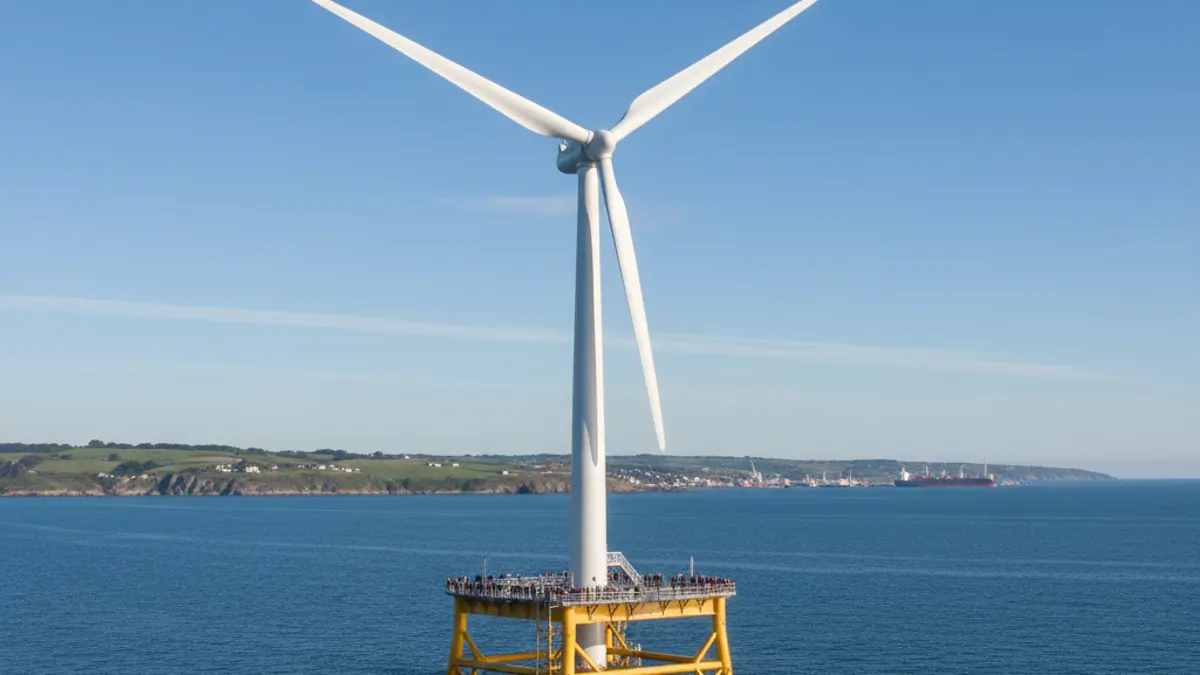
The Wheel prototype, with a power output of six megawatts (MW), represents a significant advancement for offshore wind energy in Spain. This project, led by an international consortium of 11 companies, will be the first commercial floating wind turbine in Spanish waters, at a depth of 100 meters.
Construction is taking place at the León y Castillo dock in the capital, where the barge that will transport the structure is being assembled. A spokesperson for the promoting consortium highlighted that the chosen floater design is versatile, combining the advantages of various models and suitable for any port and draft.
“"The floater model chosen for this project combines the advantages of several models and can be used in any port and draft."
The project, which is already one-third complete, is primarily funded by European sources, but also receives support from other regions, including the United States Department of Energy. This technology has been selected by Japan and Catalonia for future offshore wind energy projects.
The vice-counselor for Ecological Transition of the Government of the Canary Islands, Julieta Schallenberg, emphasized the project's importance for the local economy, stating that it “serves to test the value chain and grease the machinery” that will allow the archipelago to retain a significant portion of the economic benefits from offshore wind.
“"We need offshore wind because Gran Canaria cannot decarbonize without looking to the sea."
The president of the Cabildo, Antonio Morales, added that offshore wind energy will provide greater stability to renewable generation due to its consistency. The Wheel prototype aims for an unprecedented reduction in floater size, port draft, material usage, and carbon footprint, positioning itself as an evolved floating platform for the global expansion of floating turbines.