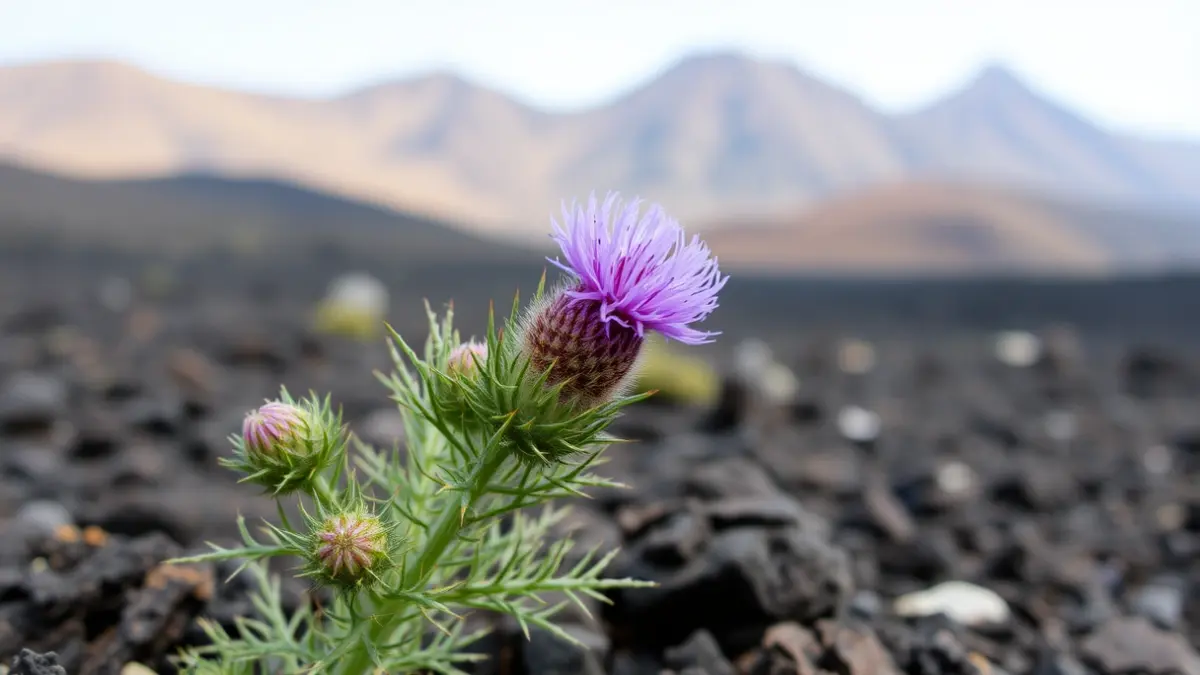
The General Directorate of Natural Environment of the Government of the Canary Islands has initiated an ambitious plan to safeguard the Tenteniguada thistle (Onopordum carduelium), a plant exclusive to Gran Canaria that is in a critical situation. The main goal is to increase the number of adult specimens to at least 3,500 and to carry out habitat improvements for the species over a minimum area of 10 hectares.
This initiative is crucial, given that the distribution of the Tenteniguada thistle is extremely limited, concentrated exclusively in the central-eastern sector of the island's summit, specifically in the Altos de la Caldera de Tenteniguada. Its population spans 29 500x500 meter grids, covering a total of 750 hectares and growing at altitudes ranging between 1,000 and 1,900 meters.
One of the most significant challenges for the implementation of this plan, which will remain in force until its objectives are met, lies in the private ownership of the land where the specimens are found. This requires negotiation and agreement with the landowners. Furthermore, the location of a large part of the population on the margins of a dirt track and near scattered constructions could limit conservation efforts in the face of potential infrastructure improvement works.
The species is listed as «endangered» in both the Spanish Catalog of Threatened Species and the Canarian Catalog of Protected Species. Currently, it is found in five different areas: Los Marteles, Cuevas Blancas, Mesa del Cuervo-Barranco de la Abejerilla, Degollada de Los Junquillos, and Barranquillo Agua del Orián. Its growth is restricted to the municipalities of Telde, Valsequillo, and Vega de San Mateo, within protected natural areas such as the Los Marteles Special Natural Reserve and the Las Cumbres Protected Landscape, as well as in the Special Conservation Zones (ZEC) of Los Marteles and Hoya del Gamonal.
The threats faced by the Tenteniguada thistle in its habitat include grazing, herbivory by rabbits, waste dumping, and trampling, especially on the margins of the track connecting Los Marteles with Valsequillo.
The plan includes 26 actions distributed across seven objectives, with varying priority levels. High-priority measures, which are mandatory, include the production of specimens in nurseries from collected seed material, population reinforcement in optimal enclaves, and waste removal in the locality of Cuevas Blancas. The estimated cost for the execution of all measures amounts to 794,109.96 euros.