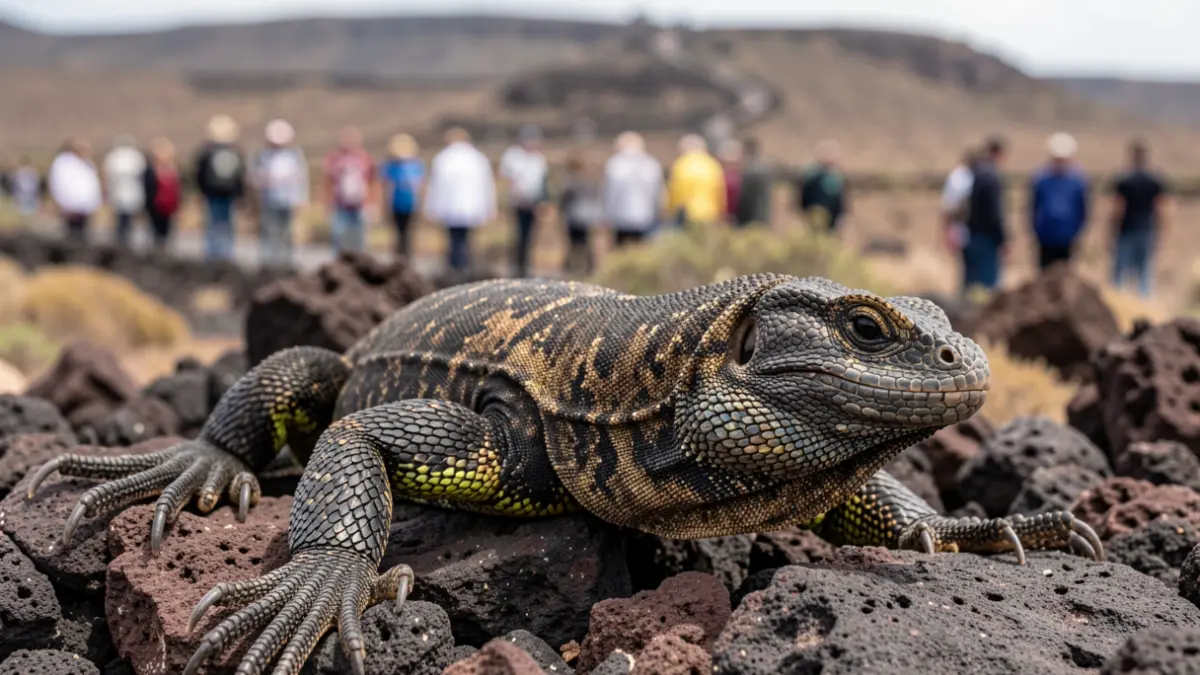
The Ministry of Ecological Transition and Energy of the Government of the Canary Islands has presented the new Recovery Plan for the El Hierro Giant Lizard (Gallotia simonyi), a crucial initiative for the survival of this species classified as endangered. The plan, with an investment of approximately two million euros, encompasses various actions including conservation, genetic improvement, predator control, habitat restoration, and the creation of new population nuclei.
During the event, held at the El Hierro Giant Lizard Recovery Center, participants included the Minister Mariano H. Zapata, the President of the Cabildo of El Hierro, Alpidio Armas, and the insular Minister of Environment, Jesús Pérez. The authorities visited the facilities to gain firsthand knowledge of the technical and scientific work dedicated to the reptile's reproduction, monitoring, and conservation.
The Recovery Center currently houses over 60 adult lizards and 93 hatchlings, figures essential for the success of the captive breeding program. Minister Zapata emphasized that the plan "represents a decisive step in further strengthening the protection of one of the most emblematic and unique species in the Canary Islands," reaffirming the regional executive's commitment to biodiversity.
For his part, Alpidio Armas highlighted that the conservation of the El Hierro giant lizard, "a unique species in the world and a symbol of the Island," is an absolute priority for El Hierro. He valued the coordinated work between administrations and the decades-long efforts at the center to prevent the species' extinction.
The new plan's measures include consolidating the natural population, increasing the number of specimens, improving genetic viability through breeding and reintroduction programs, controlling introduced predators, and restoring habitats. Furthermore, new lines of scientific research and environmental awareness are being incorporated.
The El Hierro giant lizard (Gallotia simonyi) is an endemic Canary Islands species and one of the most threatened reptiles in the Archipelago. Its conservation is key to the island's ecological balance, having been considered practically extinct until the discovery of a small surviving population in the Fuga de Gorreta cliffs. Recovery plans, initiated in 2004, have focused on captive breeding and the reintroduction of specimens.