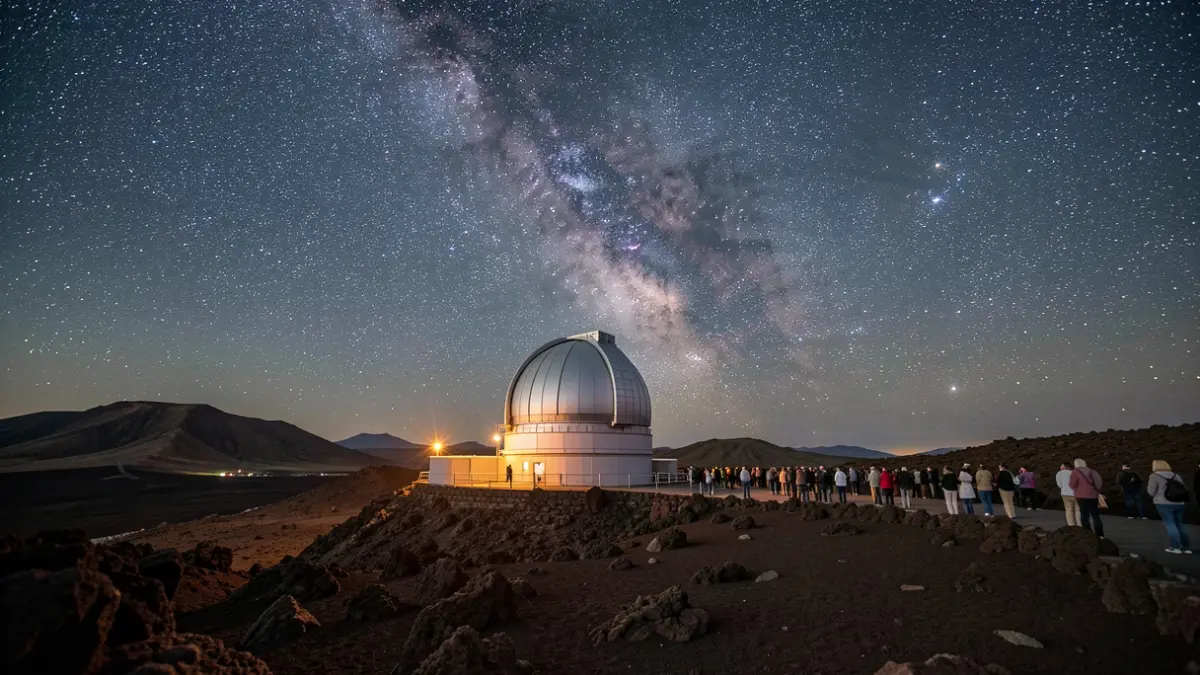
The Minister of Tourism and Employment of the Government of the Canary Islands, Jéssica de León, inaugurated this morning the new El Julán Astronomical Park, located in the municipality of El Pinar on El Hierro. This initiative is part of the Sustainable Tourism Plan in Destination (PSTD) Biosphere Reserve and is financed by the European Union's Next Generation Funds, with the goal of diversifying the island's tourism model towards astrotourism.
During the inauguration, the minister was accompanied by various insular and local authorities, including the first vice-president of the Cabildo of El Hierro, Ana González, and astronomer Daniel Padrón. The project, which involved an investment of 282,000 euros, consists of an educational module with an interpretation classroom and an automated professional module for scientific research, both equipped with advanced technology for astronomical observation.
Jéssica de León highlighted the importance of this project in establishing astrotourism as a key differentiating element of El Hierro's tourism offerings, linking tourism with science, hiking, and nature photography. She noted that the facility leverages the island's exceptional atmospheric conditions and low pollution levels, ensuring that economic activity generated remains entirely on El Hierro.
Ana González, vice-president and Minister of Infrastructures of the El Hierro Cabildo, stated that the project positions El Hierro as an international reference destination for astronomical tourism, with potential for economic revitalization and scientific dissemination.
The Director General of Infrastructures, Sustainability, and Tourist Quality, Héctor Mateo, emphasized that the initiative aligns with the Ministry's efforts to highlight the unique values of each island, creating new tourist experiences while respecting the territory, particularly as it is part of the Frontera Rural Park.
The Minister of Tourism of the Cabildo of El Hierro, Davinia Suárez, underscored the exceptional quality of the island's skies, free from light pollution, solidifying El Hierro as a privileged enclave for astronomical observation and an opportunity for the destination's growth.
For her part, the Councilor for Tourism of El Pinar, Magaly González, described El Julán as an impressive location with exceptionally clean and spectacular skies, ideal for astronomical observation. She added that El Julán is also a place rich in history, heritage, and culture, uniting nature and astronomy to offer a unique experience and reinforce El Hierro's commitment to sustainable, respectful, and high-quality tourism.
Astronomer Daniel Padrón led a practical session that included a tour of the facilities, a basic explanation of the telescopes' operation, and a demonstration of solar observation with the new equipment.
The El Julán Astronomical Park is integrated into the PSTD Biosphere Reserve, which has a total budget of 2,813,570 euros from the European Next Generation EU funds. This plan aims to consolidate El Hierro as a sustainable, low-impact, and differentiated tourism destination, reinforcing its identity as a UNESCO Biosphere Reserve and Geopark.
Other actions within the plan include the rehabilitation of the Las Cancelitas Sustainability Park (679,529 euros) to make it a benchmark for sustainable tourism and environmental education, the creation of the Los Mocanes – Punta Grande Cycling Eco-Path (1,570,041 euros) to establish a sustainable mobility corridor for cyclists and pedestrians, and the implementation of a Tourist Big Data tool (282,000 euros) to drive digital transformation and intelligent destination management.