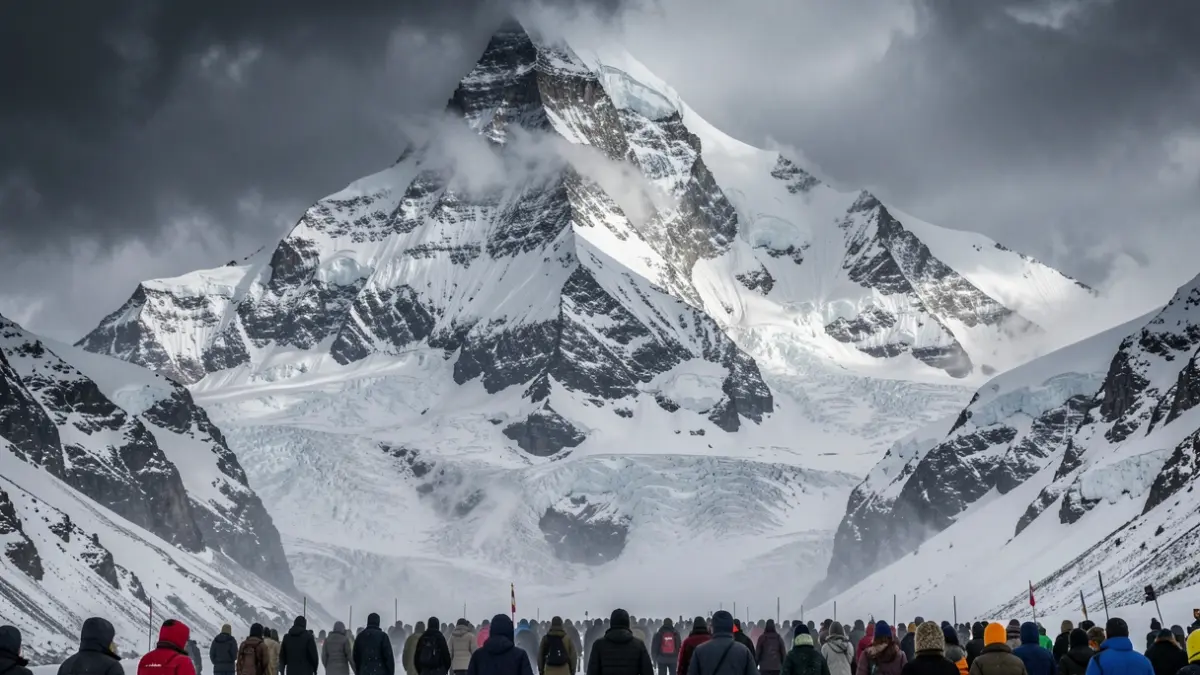
A Canarian alpinist, whose identity is being withheld, has shared his struggle on Mount Everest, describing the expedition as an experience that oscillated between the "magical" and a true "hell." During his ascent, he faced extreme weather, including avalanches and temperatures as low as -50 degrees Celsius, as well as a hurricane that prevented him from reaching the summit.
According to his account, the mountain was "very fierce, unknown," with a level of avalanches and wind not seen in 15 years, according to experts. "It truly became a hell because of the climate," he stated, highlighting the difficulty of the ascent.
“"It caught me completely head-on, there was no way to dodge it."
The athlete recounted suffering three avalanches, one of which buried two people from another expedition whom he helped rescue. The third caught him directly while descending to Base Camp 2, an incident that, according to his story, caused the deaths of three people from another expedition, which he described as a "very dramatic and very tough" moment.
In an act of self-exploration, the alpinist decided to temporarily separate from the expedition to test his own limits. He remained isolated for five days in a tent, ascending alone to the so-called "death zone," above 7,200 meters, and enduring temperatures as low as -50 degrees Celsius.
During his isolation, he recorded himself to monitor his cognitive state, assuring that he felt "perfectly fine" and capable of thinking clearly, despite his blood oxygen saturation dropping to a dangerous 32% without experiencing any hallucinations.
“"'They tell me: 'you can't go up.' I say, what do you mean I can't go up? I'm perfect.'"
Despite reaching 8,050 meters and feeling in optimal condition, the expedition prohibited him from continuing to the summit. The refusal, justified by risk, led to a strong confrontation. The intervention of the "mountain police" ultimately forced him to descend.
This decision left him with a "very bittersweet taste," especially as he denounces what he considers an injustice: while he was prevented from ascending, a person with "very, very great purchasing power" was taken up "dragged because they paid for it." Faced with this situation, he has decided that his next attempt will be independently, following his own strategy.
Despite not having reached the summit, the alpinist is satisfied with having achieved his main goal of "experiencing my limits, my capabilities." His next challenge will be to ascend Mount Elbrus, the highest peak in Europe, in July, to scatter his recently deceased father's ashes in a posthumous tribute.