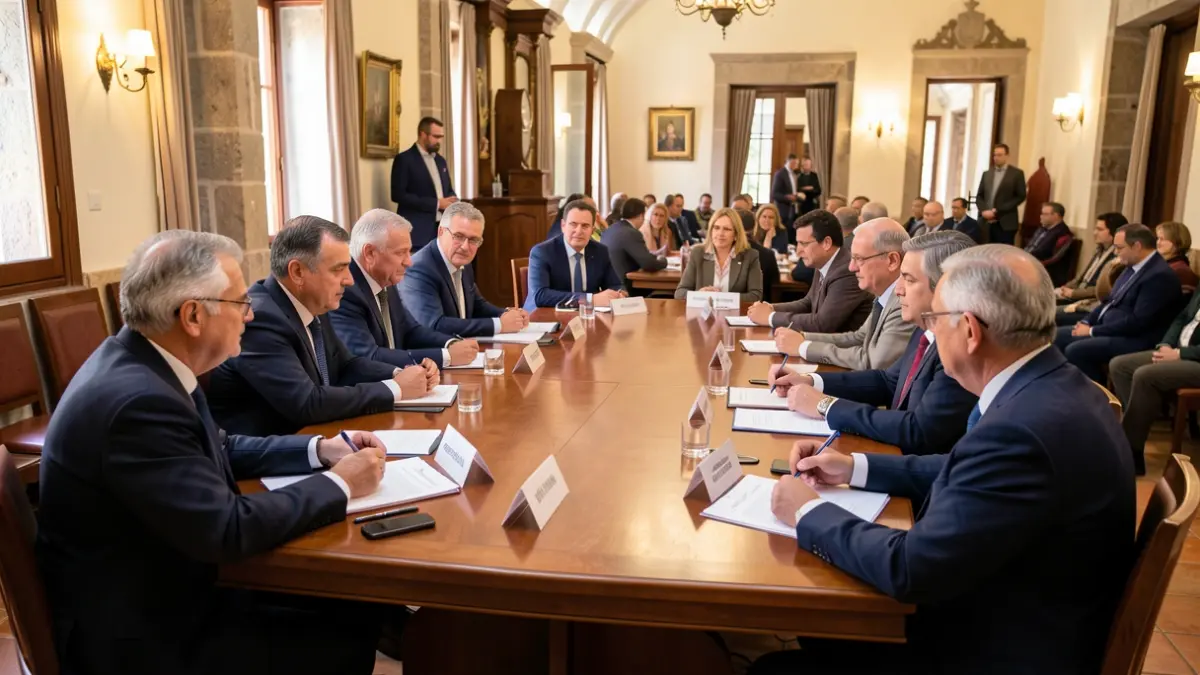
The Governing Council of Canarias has approved a set of initiatives to address the escalation of prices, which include the temporary application of 0% IGIC for energy products and fuels, the refund of 99% of the special fuel tax with retroactive effects, and the reduction of IGIC to 0% on basic products such as coffee, butter, and salt. However, the regional executive's spokesperson, Alfonso Cabello, has indicated that no further actions are planned for now, as the islands have “their hands tied.”
“"The flexibility that the State applies to itself is not extended to the autonomous communities."
Cabello reiterated that Canarias could implement a more ambitious plan if the central Government allowed for greater flexibility in spending rules or increased borrowing capacity. This stance was previously expressed by regional president, Fernando Clavijo, who estimates that these additional measures could provide an extra 1.6 billion euros for the archipelago. The spokesperson emphasized that Canarias is one of Spain's least indebted autonomous communities and that these funds would not only combat the current crisis but also address “structural challenges.”
The opposition, particularly Nueva Canarias-Bloque Canarista (NC-Bc), has described the package of measures as “meager.” Their spokesperson, Luis Campos, criticized the “ridiculous” 15 million euro contribution from the regional executive and the “insignificant” 15 million euro contribution from the State for 100 days, extendable up to 60 million. Cabello, for his part, recalled that the measures by the Government of Spain have a negative impact of 150 million euros on Canarias, a figure the regional executive estimates it will lose from the compensation fund due to reduced tax collection by the State from anti-crisis measures.
The spokesperson highlighted the “swift negotiation” led by Fernando Clavijo with the Ministry of Territorial Policy, headed by Ángel Víctor Torres, which resulted in a 60 million euro agreement. These measures, valid for 100 days, will be evaluated and potentially extended depending on the conflict's evolution. Cabello lamented the lack of contributions from the opposition and urged a “common front” to demand that the State allow flexibility in spending rules or the use of surplus funds. He also pointed out that, unlike the mainland, where 21% VAT is applied to fuel, in the islands, IGIC was already 1% and has been lowered to 0%, which reduces the margin for further tax breaks.
The anti-crisis measures will be published this Tuesday in the Official Gazette of Canarias (BOC) and will be presented to the next plenary session for approval in the Chamber. Other initiatives, such as the reduction of tax burdens for self-employed individuals earning up to 50,000 euros annually and a 7.2 million euro allocation for supporting the industrial and primary sectors of the islands, will come into force in July, once the respective ministries develop the plans.