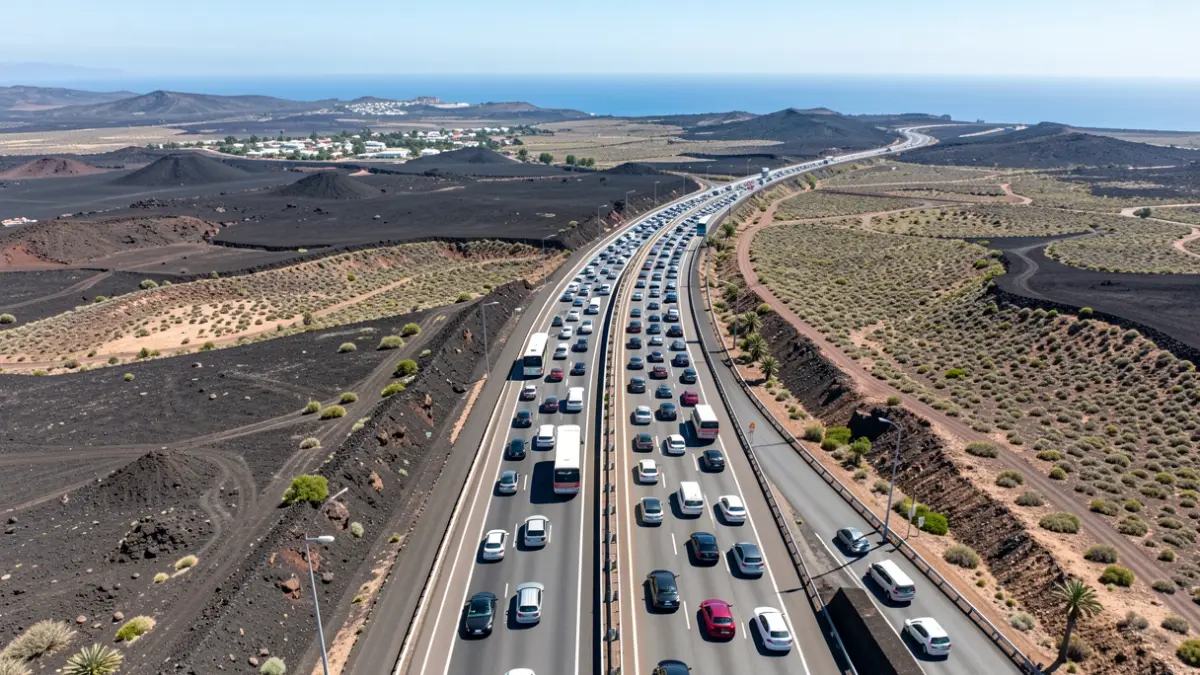
The Government of Canarias has initiated an analysis to determine the feasibility of implementing BUS-VAO (bus and high-occupancy vehicle) lanes on the GC-1 and GC-3 highways, key access corridors to Las Palmas de Gran Canaria that experience recurrent congestion. The study, awarded to the public company INECO for 202,603 euros, will last eight months and is expected to conclude in the first quarter of 2027.
The Department of Public Works, Housing, and Mobility aims to ascertain if these routes can integrate lanes for public transport and shared vehicles using Intelligent Transport Systems (ITS). The final decision on implementing these measures will depend on the technical, economic, territorial, and environmental conclusions of the analysis.
The study will cover the GC-1 from kilometer 3 to Gran Canaria Airport and the GC-3 from its junction with the GC-1 to the University of Las Palmas de Gran Canaria. These routes handle a high volume of daily travel and experience frequent traffic problems.
The first phase of the study will focus on collecting current mobility data, including traffic counts and analysis of public transport offerings and available cartography. Subsequently, traffic simulations will be conducted to assess how the road network would respond to the implementation of BUS-VAO lanes, aiming to identify alternatives that improve capacity and flow.
Furthermore, a socioeconomic evaluation will be carried out, considering time savings for users, reduction of pollutant emissions, road safety, and the costs associated with each option. The final document will prioritize corridors with the best conditions for implementation, based on technical, economic, social, and environmental criteria.
Rosana Melián, Director General of Road Infrastructure, highlighted that the study will enable rigorous decisions to improve mobility in Gran Canaria, optimize existing infrastructure, and promote public transport. If the results are favorable, the drafting of corresponding construction projects will be advanced, in coordination with the Cabildo of Gran Canaria and the General Directorate of Traffic.