
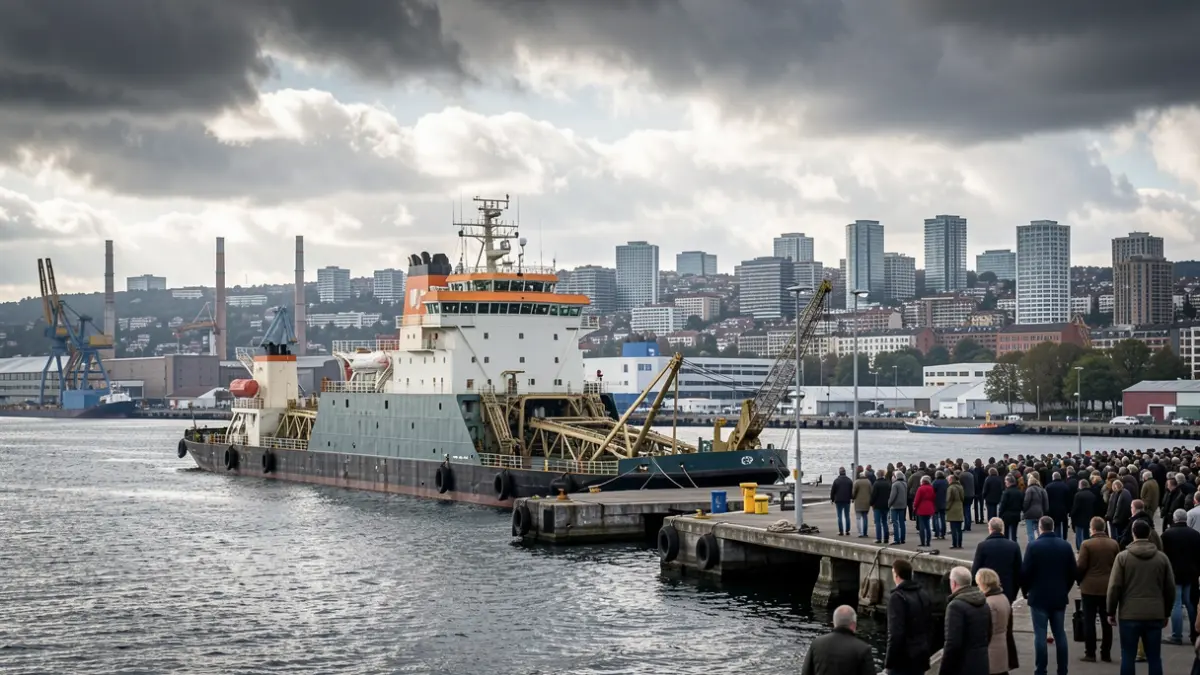
The Minister of Ecological Transition of the Government of the Canary Islands, Mariano Hernández Zapata, has defended the installation of a floating power plant in the port of La Luz and Las Palmas, stating it will be a “punctual and temporary” measure that will not affect the port's operations.
Responding to a question from the Socialist Group, Zapata indicated that the plant will only be activated in case of a blackout risk in Gran Canaria, after other options have been exhausted. He added that the vessel will be moved once the central government's thermal power plant renovation tenders are concluded, processes that typically take years.
The minister described this option as the “only viable one” to guarantee electricity supply, capable of covering up to 100 megawatts. Despite being a Turkish-flagged ship, he affirmed it will comply with all European Union environmental requirements, and that the government could not “stand idly by”.
The use of batteries was ruled out, considering the technology not yet mature enough to meet the high demand of islands like Gran Canaria or Tenerife. It was clarified that the ship will only become operational after the environmental impact assessment process is completed.
Zapata highlighted the coordinated work with the Ministry of Ecological Transition to make emergency generation a reality in the Canary Islands. He criticized the previous government for inaction despite a report from Red Eléctrica warning of blackout risks.
For her part, Alicia Vanoostende (PSOE) expressed concern about the installation of a floating thermal power plant, citing its use of fossil fuels and its proximity to residential areas, port facilities, and environmentally sensitive zones.
The socialist deputy called on the Executive for maximum transparency, safety, and protection of public health and the environment. She warned about the vessel's history, including involvement in hydrocarbon spills in the Dominican Republic and cancelled projects in South Africa.
Vanoostende also recalled the significant social opposition to the installation of Totisa, near Las Palmas de Gran Canaria, due to its potential effects on air quality and public health. She requested an independent study on the impact on air quality and projected emissions, as well as a contingency plan for potential accidents.
Finally, the socialist representative advocated for more coherent alternatives like batteries, criticizing that while citizens are asked to reduce emissions, the government opts for fossil fuels.


