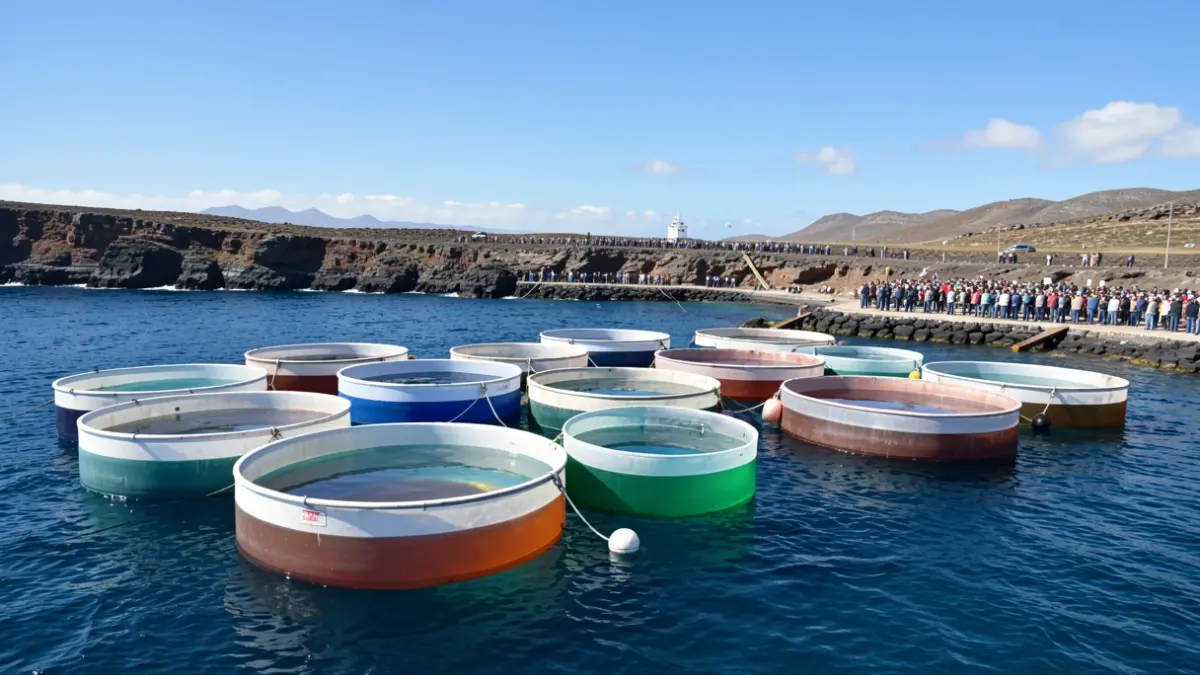
An innovative scientific experiment is underway at the Taliarte dock in Telde, aiming to assess the potential of concrete waste in mitigating climate change in the ocean. Twelve mesocosms—large floating test tubes isolated from the surrounding marine environment—have been deployed for this purpose.
Researchers are studying how the use of ground concrete can increase seawater alkalinity. This process aims to enhance the ocean's capacity to absorb atmospheric carbon dioxide while simultaneously reducing ocean acidification, a phenomenon detrimental to marine life with calcareous structures like mussels and corals.
Professor Emeritus Dr. Ulf Riebesell, a marine biologist at GEOMAR and co-leader of the experiment, explained that the test compares a liquid alkalinity source with crushed concrete debris to evaluate their tolerance in the marine environment. This study is part of the international research project OceanAlkAlign, which seeks to standardize measurement and evaluation methods for Oceanic Alkalinity Enhancement.
The experiment, set to last seven weeks, is conducted in collaboration with PLOCAN, a long-standing research partner of GEOMAR. The initiative arises from the need for active carbon dioxide removal methods, as emission reductions alone may not suffice to meet the goals of the Paris Agreement.
The increase in atmospheric CO2 since industrialization has led to significant dissolution in the ocean, altering its chemistry and contributing to global warming. Oceanic Alkalinity Enhancement is considered a promising option, provided it can be implemented effectively and in an environmentally responsible manner.