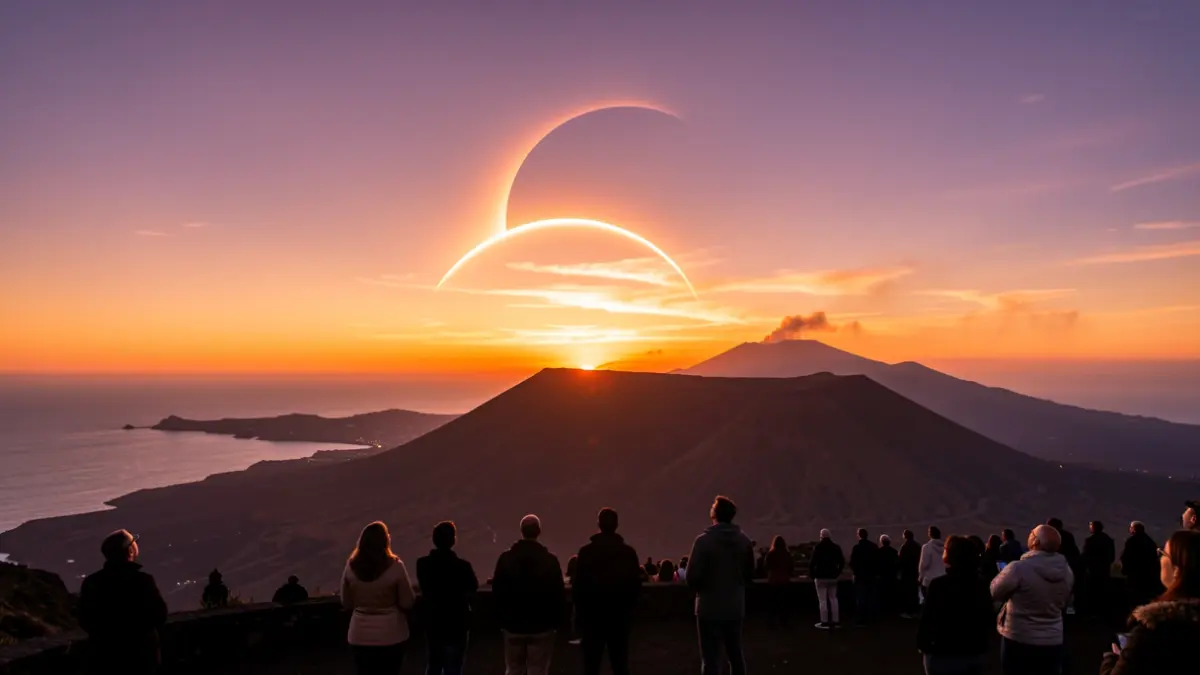
The solar eclipse, the first of three predicted until 2028, captivated thousands of residents and visitors in the Canary Islands. Although the phenomenon was not total on the islands, the sun was covered by 74% at its peak at 7:55 PM, offering a memorable spectacle.
Demand for special glasses to safely observe the sun was high, with queues at the eight observation points set up by the Elder Museum of Science, part of the Canary Islands Government's Tourism Department. Thousands of people mobilized throughout the archipelago, choosing beaches, viewpoints, terraces, and high-altitude areas with generally clear skies.
Locations such as Tejeda welcomed around 1,500 people, while other places like La Santa in Lanzarote and the Castillo de El Tostón in Fuerteventura also saw large crowds. Many opted to enjoy the event in more secluded spots, such as Guayedra beach in Agaete.
Celeste and Irene, residents of Las Palmas de Gran Canaria, described the experience as "like a movie, a fantasy book." Carolina and Diego, accompanied by their dogs Linda and Pepe, also traveled to Agaete to witness the eclipse, having obtained protective glasses "at the last minute."
The Government of the Canary Islands activated the pre-alert of the Territorial Plan for Civil Protection Emergencies due to the anticipated increase in travel. The Cabildo of Gran Canaria closed the Tamadaba massif and the GC-216 road to prevent forest fires. In Tenerife, a special traffic management operation was implemented to control access to El Teide National Park.
The Guardia Civil Command of Las Palmas deployed a special operation, regulating traffic and monitoring to prevent recklessness. Despite some crowds and improperly parked vehicles, citizen behavior was "exemplary," according to sources from the force, who highlighted the absence of barbecues or fire hazards.
The Canary Islands Institute of Astrophysics (IAC), which leads the North African Telescope Eclipse (NATE) project, used the event to test its equipment for future endeavors. The Canary Islands will again witness a partial solar eclipse on August 2, 2027.