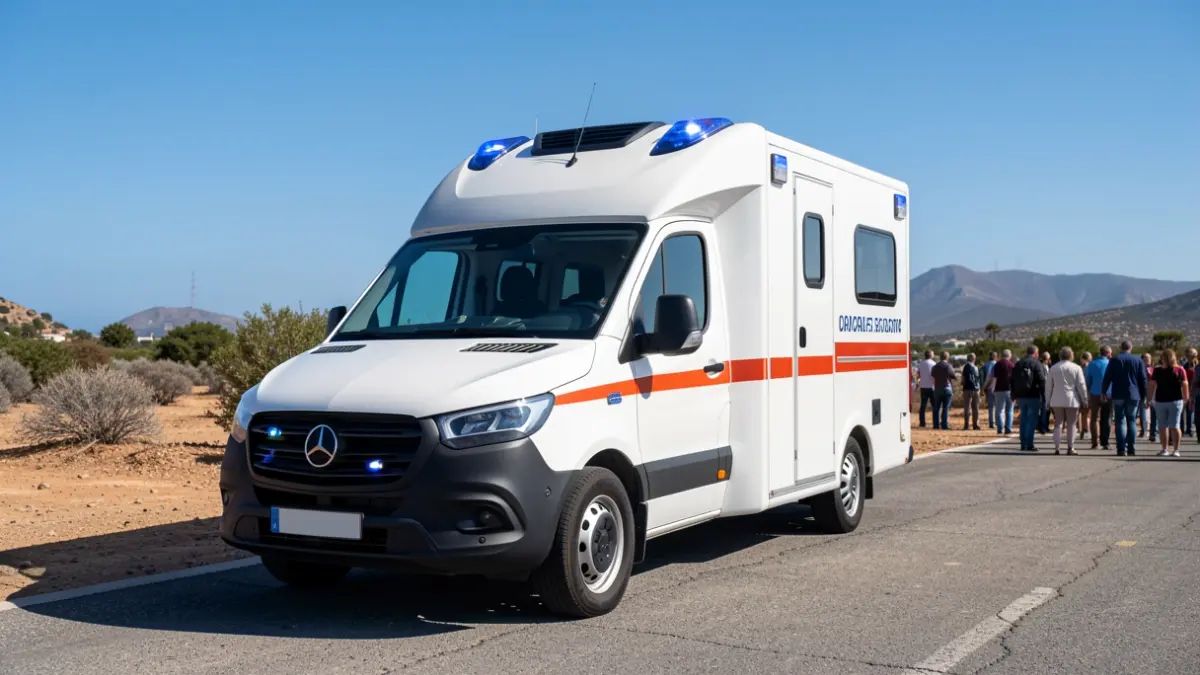
The island of Fuerteventura will strengthen its urgent healthcare transport network with the addition of three new ambulances. Two will be advanced life support with nursing care, located at the health center in Corralejo and in Gran Tarajal. The third will be basic life support and will serve El Castillo. These new vehicles will join the existing fleet of nine ambulances, comprising two advanced life support medicalized units and seven basic life support units.
Nationalist parliamentarian Mario Cabrera emphasized the need to expand the transport network given the island's length and its floating population. Meanwhile, the Minister of Health for the Government of the Canary Islands, Esther Monzón, announced that the plan is for Fuerteventura to increase its emergency response capacity with the upcoming service tender.
However, the PSOE has criticized the announcement, calling it the creation of 'false expectations.' Socialist deputy Manuel Hernández Cerezo stated that the new ambulances cannot be operational until the new urgent transport contract is tendered and awarded, a process that union representatives do not expect to be completed before late 2027 or early 2028, due to a labor dispute in the sector.
The two advanced life support ambulances will be assigned to Gran Tarajal, strengthening the south and southeast of the island, and to Corralejo, to enhance coverage in the north, an area with high tourist influx and specific healthcare needs. The basic life support unit in El Castillo, municipality of Antigua, will increase response capacity in central Fuerteventura.
Esther Monzón highlighted that these resources, along with the medicalized helicopter incorporated earlier this year, will establish a healthcare transport network that is 'more complete, better distributed, and more territorially balanced.' These advancements are based on a technical study analyzing healthcare activity, geographical dispersion of the population, and the demographic characteristics of Fuerteventura.
Mario Cabrera stated that the provision of these three ambulances fulfills the objective of 'equipping the island with a more urgent and better-distributed transport network,' adapted to current demands driven by population growth and the long distances between population centers.
The PSOE, on the other hand, considers the announcement a 'propaganda strategy based on headlines that generate unrealistic expectations.' Manuel Hernández described it as 'irresponsible' to announce new ambulances without the tender having been launched.