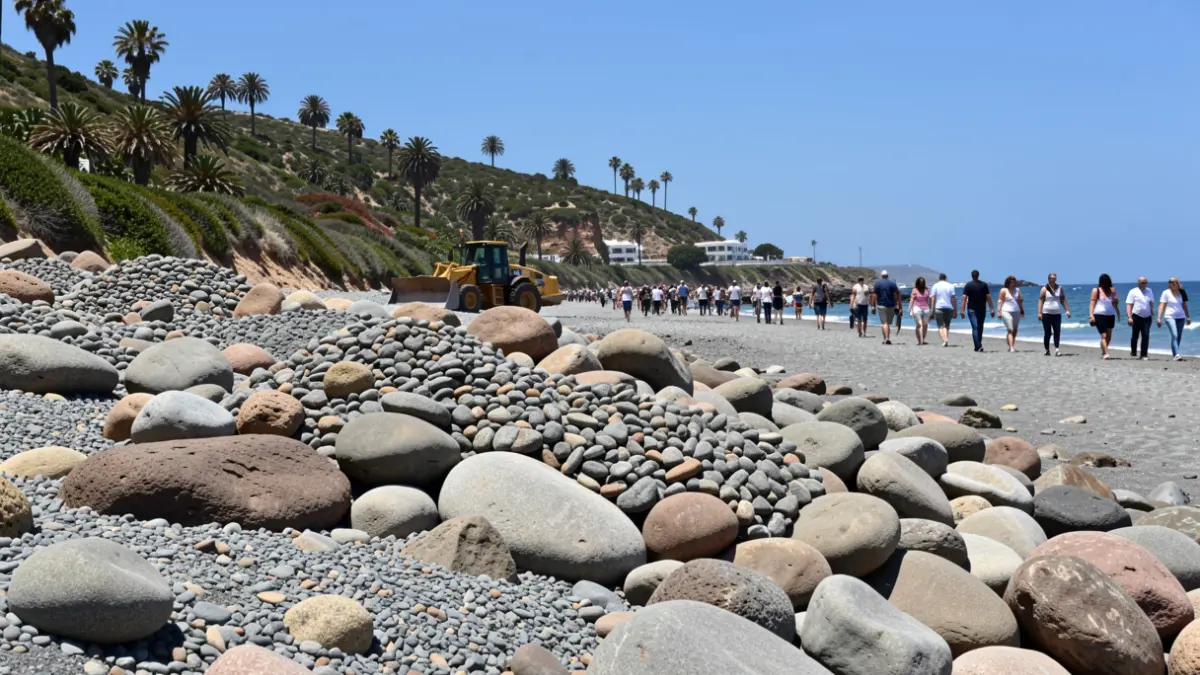
More than 30 environmental collectives from all over the Canary Islands have requested this Thursday from the Directorate General of Coasts of the Government to clarify the nature of the earthmoving activities that the company Lopesan is carrying out in the natural environment of Veneguera, in Gran Canaria.
Among the signatory organizations are Ben Magec, Turcón, Canarias Insumisa, Salvar La Tejita, ATAN, Salvar Chira-Soria, and the Fundación Telesforo Bravo. They have expressed their concern over these works, which involve the movement of large quantities of rounded stones and aggregates on the beach itself, without the proper informative signage.
The collectives warn that heavy machinery has removed the characteristic natural slope of the beaches in western Gran Canaria, dragging "large quantities of rounded stones and aggregates from the beach itself towards the area of the old car park," where they have been buried.
“"We demand that Costas clarify exactly what Lopesan's supposed renaturalization project in Veneguera consists of, what actions it includes besides those already executed, and under what technical, environmental, and administrative criteria these movements of aggregates and stones are being carried out."
Likewise, they have requested to know the public environmental reports that support these actions and the true objectives of the intervention on the beach and its surroundings.
The environmental groups recall that, according to their statement, Lopesan "has destroyed important areas of tamarisk groves in the riverbed, eliminated valuable habitats of centuries-old cardonal spurge on the slope known as Tabaibales", in addition to having "modified the riverbed on multiple occasions, destroyed an archaeological site in 2023 of enormous heritage value, facts that are currently under judicial investigation, and cut off access roads and paths."
Given this background, the collectives warn that it could be "a new episode of progressive intervention on one of the last semi-virgin places" in Gran Canaria, a situation that concerns them "profoundly".
Veneguera does not belong to any company: it belongs to the collective memory of those who defended it and to the right of all people to continue enjoying it freely.