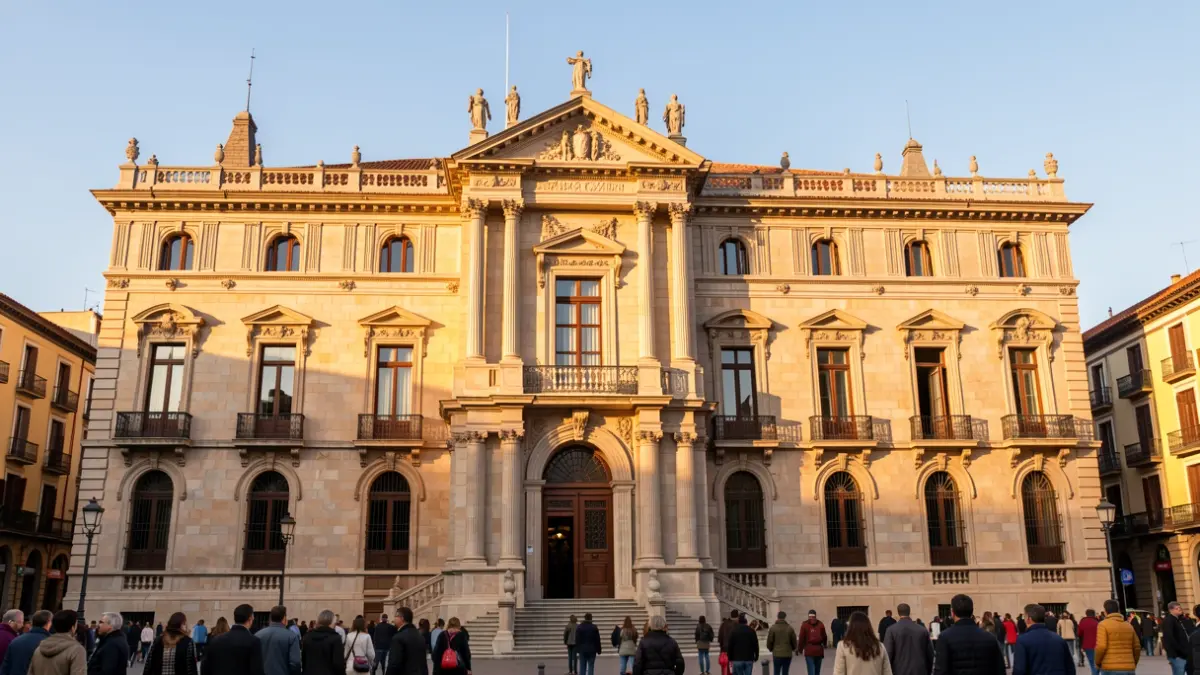
Pope Leo XIV landed at El Prat airport, where he was welcomed by President Salvador Illa, who had previously met with the leader of the Catholic Church. The meeting, held at the Episcopal Palace, the seat of the Archbishopric of Barcelona, lasted for half an hour.
During the meeting, Illa thanked the Pontiff for his "sensitivity" towards Catalonia and they discussed the international situation, the advancement of technology "at the service of humanity," and the need to "welcome those who are different." The president described the audience as "very good" and highlighted the Pope's willingness to accept the invitation extended last year.
“"I never had any doubt that he would show, also by speaking in Catalan, his sensitivity"
The Government of Catalonia organized extensive activities for the papal visit, including events, the president's schedule, and an institutional campaign. The Vatican flag flew at the Generalitat and the Barcelona City Council, a gesture also made during Benedict XIV's visit in 2010. The government maintains that, despite its accompanying role, the visit is a "unique opportunity to project" Catalonia as an "open, welcoming, and dialoguing" territory.
Illa presented the Pope with a letter requesting the use of Catalan during the blessing of the Sagrada Família, along with three symbolic gifts: a reproduction of the 'Homilies d’Organyà', an ivory figurine from the early Christian necropolis of Tarraco, and the record of the laying of the first stone of the Sagrada Família. These gifts, according to the president, "symbolize the living history" of Catalonia and its "deep Christian roots".
The president believes that the Pope's message, who urged the citizens of Catalonia to be "builders of unity," "resonates" with Catalan values, especially in the context of the rise of the far-right. Teacher protests and issues with the Rodalies train service were minor compared to the main day of the papal visit.