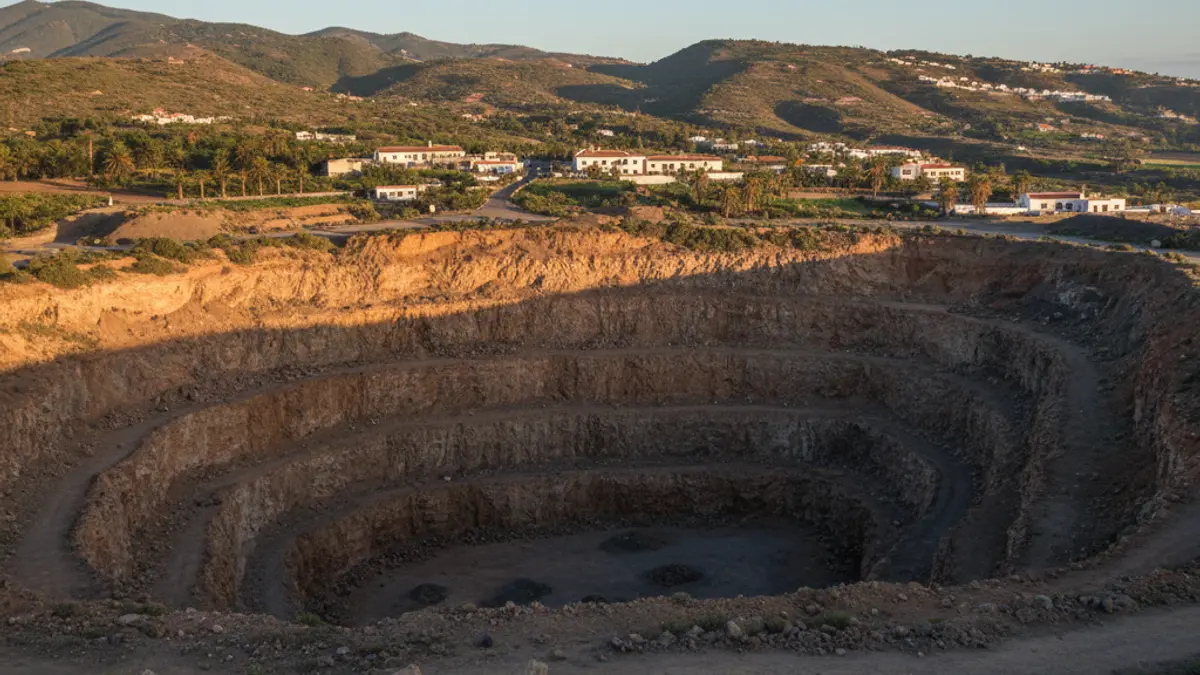
The construction of the Tenerife hydroelectric plant in the Badajoz ravine, scheduled for next year, will utilize two large pits created by five companies that extracted aggregates for nearly half a century. The project's execution requires the reclassification of the affected land and for the Government of the Canary Islands to enforce the Supreme Court ruling, which assigns it the responsibility of collecting the 185 million euros earmarked for the area's rehabilitation.
To date, the Ministry of Ecological Transition and Energy of the Government of the Canary Islands has commissioned the public company Gesplan to prepare an environmental recovery study. A ministry spokesperson stated that the pumped-hydro power plant is the best option to restore the ecological disaster in the Güímar Valley, taking advantage of the existing space for reservoirs.
“"We have always maintained that the best option to environmentally restore the ecological disaster of the Güímar Valley is to promote a pumped-hydro power plant there, taking advantage of the fact that we already have the necessary space for the reservoirs. Today we can say that this historical problem has found a solution."
However, nearly 21 years after the start of the ecological crime proceedings, silence persists regarding the enforcement of the sentence. A plaintiff's lawyer has expressed his expectation that the regional Executive will report on what has been collected and who has complied with payments, recalling that some businessmen avoided prison through an agreement that included rehabilitation and payment for restoration.
The sentence stipulates that the regional Executive must rehabilitate the ravines with the money from those convicted. The collection of the 185 million euros remains one of the main unknowns for the plaintiffs, who demand strict compliance with the judicial resolution. The Supreme Court dismissed the appeals from the businessmen, thus upholding the order from the Second Section of the Provincial Court of Santa Cruz de Tenerife.
The future hydroelectric plant, which does not yet have an approved project, will occupy two of the six existing aggregate quarries. One of them is the Badajoz quarry, and the other is the Agache quarry. A spokesperson for the plaintiffs has indicated that any work in this enclave should be preceded by the collection of the established amount.
The figure of 185 million euros is significantly lower than initial estimates. An expert appraisal from 2010, commissioned by the private prosecution, valued the damage at 203 million euros. Another document from 2016, prepared by the Insular Water Council of Tenerife (Ciatf), estimated the necessary investment to recover the area at almost 345 million euros.
The Provincial Court rejected the restoration proposals from the convicted businessmen, based on a report from the General Directorate for the Fight Against Climate Change and Environment of the Government of the Canary Islands. This 2020 report deemed the plans «unenforceable» because they would generate atmospheric pollution, contribute to climate change, cause public unrest, and harm health, among other issues, due to the need for over 1.7 million truck trips to fill the voids.
The environmental restoration of the Güímar ravines must be financed by the convicted businessmen, as established by the Provincial Court in 2016 and ratified by the Supreme Court in 2023. A spokesperson for the plaintiffs hopes that the Government of the Canary Islands will collect the 185 million euros before any other agreement with the infringing businessmen, who remain the landowners. A spokesperson for the Ministry of Ecological Transition and Energy has confirmed that negotiations are underway for the availability of the land for the hydroelectric plant.
This infrastructure, a project by Red Eléctrica de España, represents an investment exceeding one billion euros. It will have 200 megawatts of power and will be able to store approximately 3,200 megawatt-hours, covering one-third of Tenerife's daily electricity demand. Its useful life is estimated to exceed 75 years, and it is expected to be fully operational within 10 to 12 years.