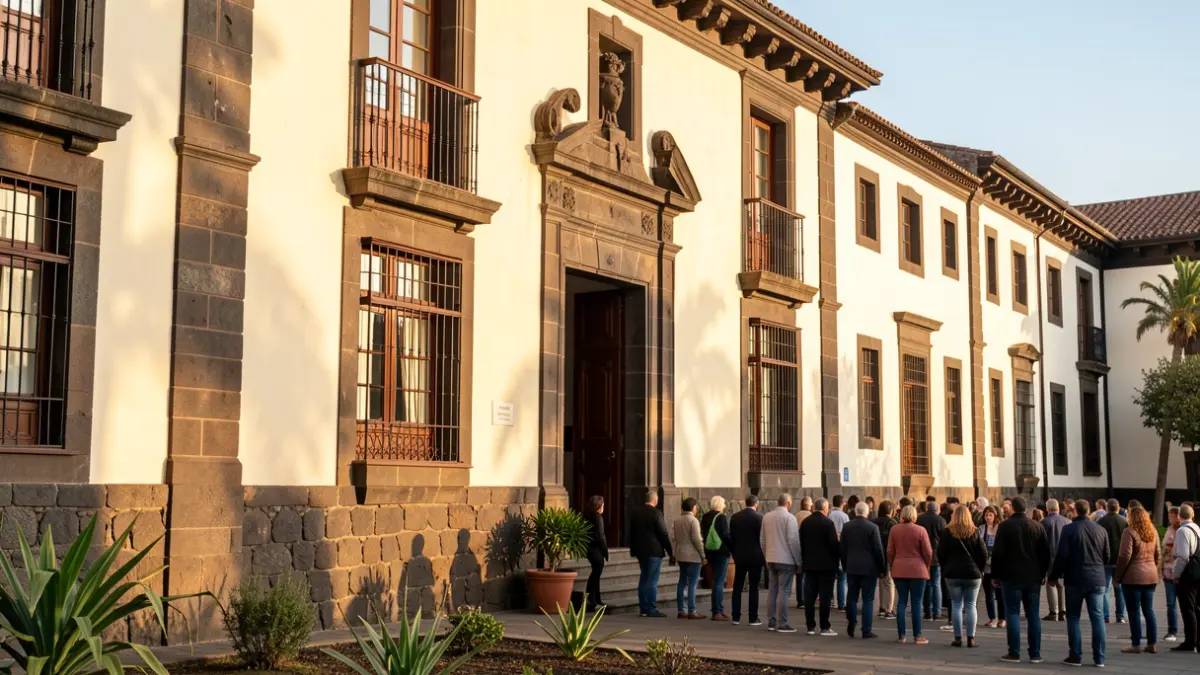
The South Campus of the University of La Laguna, located in the municipality of Adeje, inaugurated its 2026-27 academic year today, Wednesday, September 23. The ceremony, held in the town's auditorium, was attended by the academic institution's rector, Francisco J. García Rodríguez; the acting mayor-president, José Miguel Rodríguez Fraga; and a broad representation from both the host municipal corporation and the university government team. The inaugural speaker was Raquel Huete Nieves, a professor from the University of Alicante, with the lecture “Why is Tourism Sustainability a Social Issue?”.
Rector García Rodríguez emphasized the role of public universities as bastions of science-backed truth against "post-truth" and "opinion-mongering," quoting former Harvard president Derek Bok: "If you think education is expensive, try ignorance."
García also highlighted the excellent over thirty-year relationship with the Adeje City Council, which began with summer courses and led to the establishment of the campus, having already trained 150 Tourism graduates. He reaffirmed the commitment to strengthen and revitalize this project, mentioning the upcoming XX International Colloquium on Tourism Geography and a future edition of ULL Opina focusing on the last 25 years of tourism in the Canary Islands.
For his part, Mayor Rodríguez Fraga stressed that knowledge is a key competitive value for tourism, the region's main economic activity. He advocated for nurturing it and facing its challenges with "human intelligence, critical, serious, and rigorous thinking," not just slogans, defining tourism as a social activity requiring added value from knowledge and training.
Rodríguez Fraga recalled that the campus is now fully in-person, an aspiration long held by Adeje. The municipal corporation is improving facilities to adapt to growth, giving a "second boost" to the project that started from scratch, emphasizing the importance of coexistence and comprehensive training for future sector leaders.
Professor Raquel Huete noted that tourism must confront global challenges, seeking prosperous businesses that benefit all of society. She described tourism as a "total social fact" influencing culture, politics, housing, and landscape. She acknowledged difficulties such as unequal benefit distribution, pressure on infrastructure and natural resources, and a global "legitimacy crisis."
Huete criticized the lack of market diversification, dominated by the "sun and beach" model and urban development interests, as well as "touristification" in city centers leading to homogenization and loss of local essence. She also addressed the complexity of tourist types, including digital nomads and expatriates.
The speaker questioned the term "quality tourists" versus "mass or binge tourism," arguing the issue lies not with tourists but with the lack of policies and planning that prioritize residents. "We residents are many," she clarified, encompassing everyone who lives and participates in the social space.
She advocated for collaborative governance with permanent citizen participation mechanisms, beyond quadrennial voting, to decide on the desired society. A fairer and more sustainable tourism, she concluded, requires collectively deciding on a society that is more just, egalitarian, and inclusive.