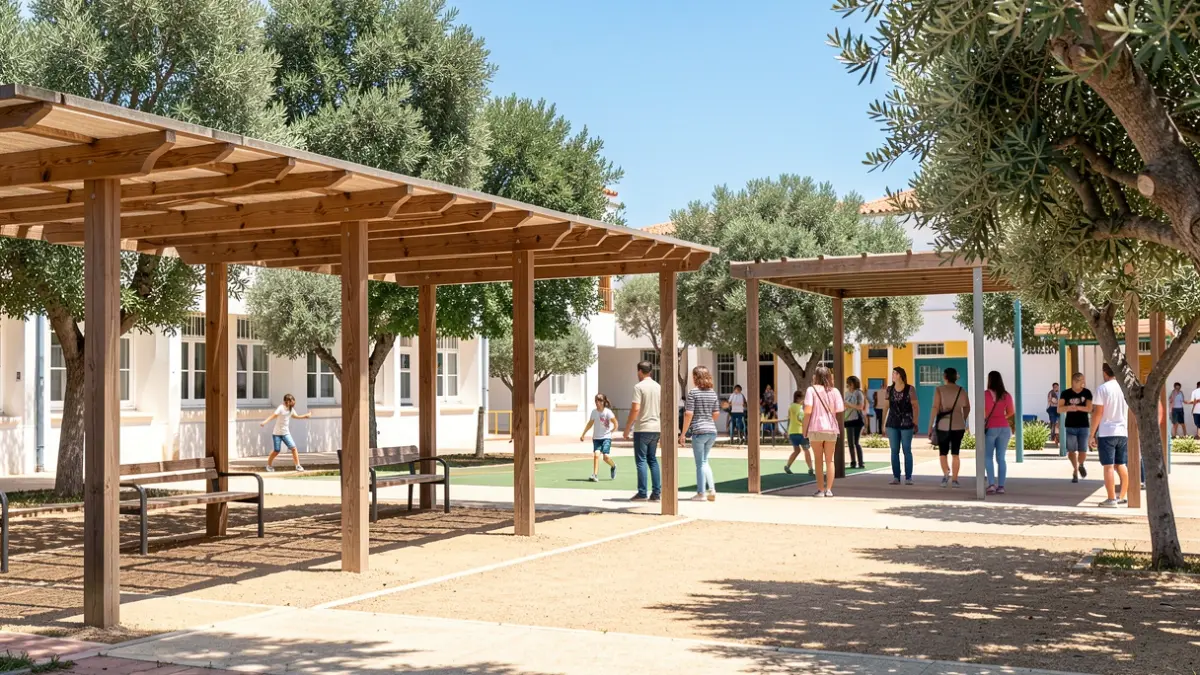
The Ministry of Education in the Canary Islands has highlighted that only two out of every five educational centers in the Archipelago have guaranteed shaded areas. This data emerges from a plan launched two years ago to adapt schools and institutes to high temperatures, through the renaturalization of spaces and facade interventions. The initial goal was to equip 279 centers, and although this figure has been surpassed with 329 schools and institutes now having these areas or with ongoing installation work, the total percentage barely reaches 38.5%.
The selection of centers for these interventions has been based on priority criteria, such as the level of solar radiation. The islands of Lanzarote and Fuerteventura, along with the south of El Hierro, La Gomera, Tenerife, and Gran Canaria, and the east of La Palma, have been considered priorities. Consideration has also been given to whether the centers offer compulsory education and if they have collaboration agreements for their funding. According to Iván González, Director General of Infrastructure and Equipment, all centers in Lanzarote, Fuerteventura, La Graciosa, La Gomera, and El Hierro already have shaded areas or are in the process of installation.
González anticipates that another 150 centers will join these actions throughout the year. If this projection is met, more than half of the educational centers in the Islands (56%) would have shaded areas. However, this progress is overshadowed by the funding received by Canarias from the Government of Spain.
Despite the plan being primarily funded by the Canary Islands' own funds, the distribution of 200 million euros approved by the Council of Ministers for the air conditioning of public schools proved insufficient for the Archipelago, which only received nine million. The Minister of Education, Poli Suárez, described this figure as insufficient and requested it be raised to 20 million. According to González, the ministry distributed the funds based solely on the number of centers, ignoring climatic factors and the additional cost of insularity.
Canarias proposed a scoring system that would value the number of centers (70%), climatic reality (20%), and insularity and status as an outermost region (10%). However, the Ministry maintained its initial criterion, which considerably disadvantages Canarias, as it would have received approximately 20 million euros according to the proposed criteria by the regional government. This difference of eleven million represents a significant grievance and limits the capacity for action in all educational centers.
The adaptation plan also includes the renaturalization of spaces, incorporating green areas such as school gardens. Around 410 centers have applied for this call, of which 84 are already in the remodeling phase, and another 50 are expected to join this year. Other measures include facade remodeling, roofing of sports facilities, implementation of cooling systems and renewable energy, as well as a protocol for action in case of high temperatures and training on climate change.
The Clima Escolar Canarias project monitors parameters such as temperature, humidity, and air quality in real-time in 120 educational centers across the eight islands. The plan is to expand this network to an additional 200 centers to facilitate decision-making and potential class suspensions.