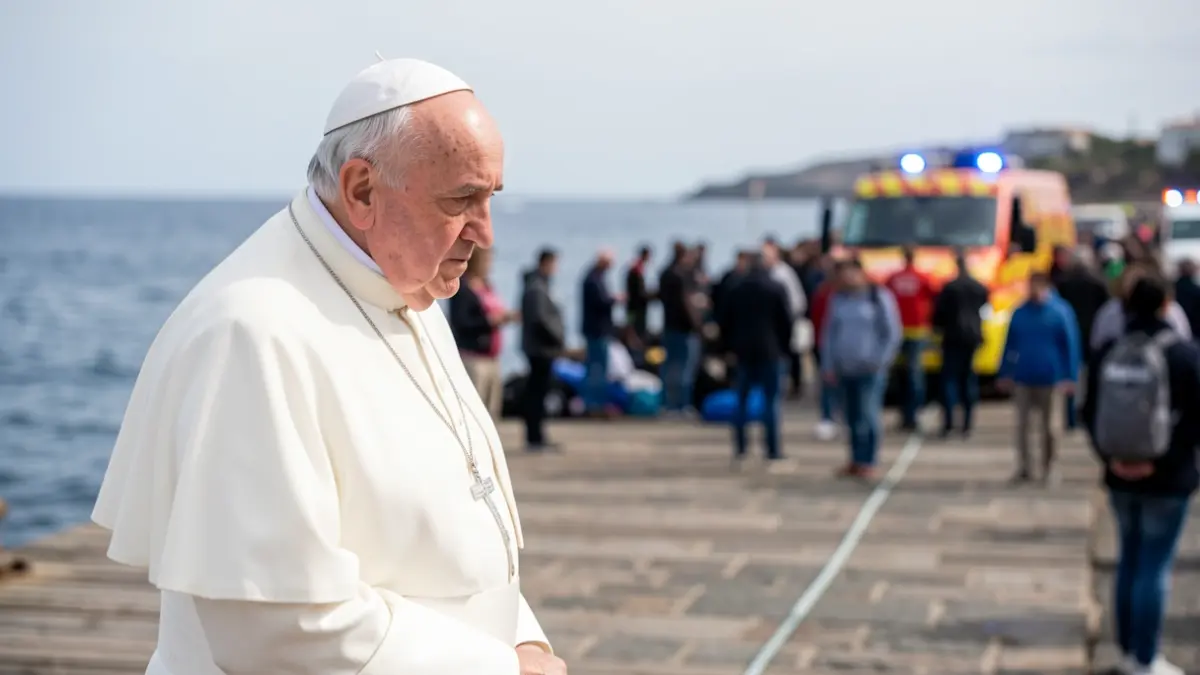
Following an emotional farewell in Barcelona, Pope Francis, the first pontiff to set foot on Canarian soil, landed in Gran Canaria for the penultimate stage of his historic trip to Spain. In Arguineguín, accompanied by the President of the Government, Pedro Sánchez, he visited the dock, which the Church aims to transform into a "dock of hope". There, he blessed a cross made from the wood of migrant boats and laid flowers in memory of the victims at sea.
Visibly moved, the Pope proclaimed: "Europe cannot become accustomed to the Mediterranean and the Atlantic being cemeteries without tombstones." He recalled that "they are not numbers or files. They are people with families and homes left behind," after listening to testimonies, including that of Blessing, a victim of trafficking who spoke without showing her face.
“"You are people with families and homes left behind; with dreams that no one has the right to despise. But I also want to tell you that your life must be protected. Do not hand over your existence to those who trade with it. Do not believe those who promise easy paradises in exchange for your body, your money, your silence, or your freedom. Those false promises are "siren songs"."
The pontiff concluded his address by warning that "history will not have to accuse us of having turned the suffering of those who suffer into the usual landscape of our coasts." He pointed out that "every life that arrives asks us what remains of our humanity" and that "sooner or later, it will be known whether we knew how to protect it or if we let indifference speak for us."
The Pope emphasized that "here the Gospel tears us from the comfortable position of the spectator and places us before the brother who arrives," asking if we have recognized Christ in those who disembark "marked by fear, hunger, and violence." He cited El Hierro, mentioning the fragility of the rafts (cayuco) and the arrival of "people recovered from the sea and lifeless bodies rescued from the waters," stressing that "the Successor of Peter cannot turn away from these docks."
He denounced the existence of "monsters lurking in these seas: mafias trafficking in desperation, traffickers enslaving women and children, and the indifference of many." He thanked the work of Caritas and other institutions, urging them to stop seeing migrants "as just another number" and to understand that "that girl could be our daughter, those faces part of our family."
“"Your life does not belong to those who harmed you; your body does not belong to those who took advantage of you; your days do not belong to those who wanted to chain them to fear. Your life belongs to God and retains a dignity that they cannot take away from you. And we want to walk with you until that truth is felt again, stronger than the pain."
The pontiff reiterated that it is not enough to "manage arrivals, distribute figures, reinforce borders, or lament deaths." Each boat brings a question about the world we have built, "if so many brothers have to risk death to seek life." He advocated for "legal and safe pathways, rescue and assistance, real cooperation against traffickers, effective protection for victims, serious reception and integration processes, and policies that allow every person to live with dignity in their own land."
Finally, quoting Saint Augustine, the Pope concluded by praying that "the God who 'at the close of life will judge us on love' may grant us to recognize Him today in the poor and the strangers, and free us from looking at the pain of others as if it did not belong to us."