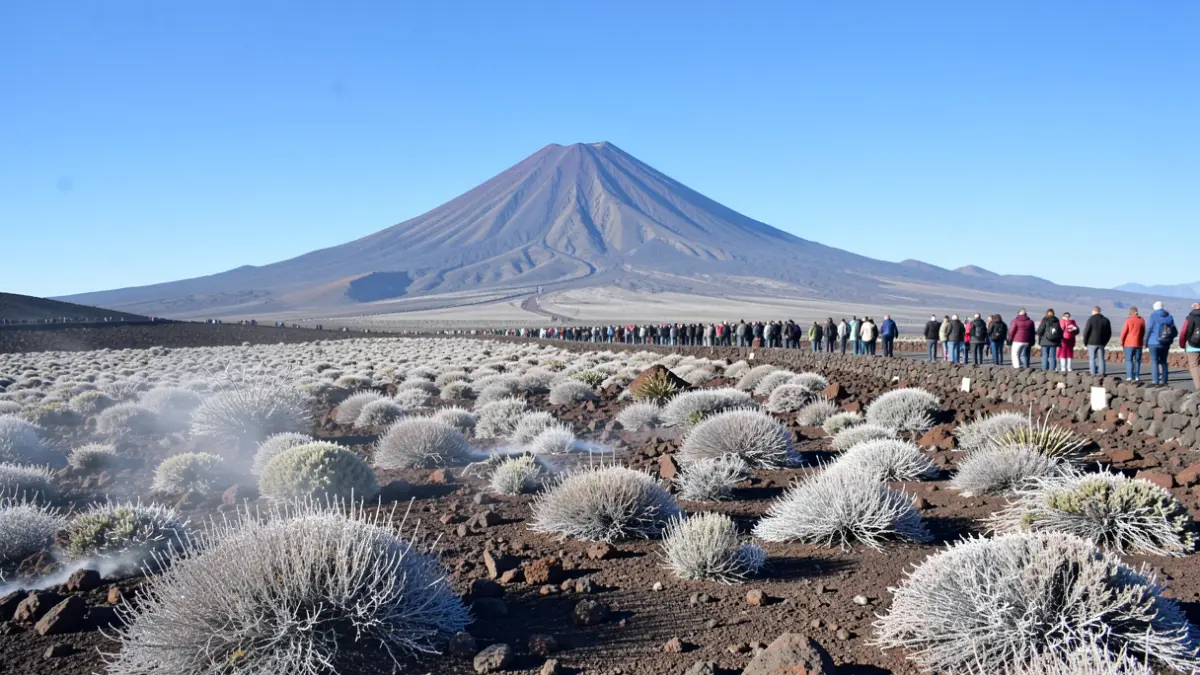
On the slopes of Teide, near El Portillo, lies an area with a unique meteorological phenomenon: a 'frozen air lake'. This location experiences extreme temperatures, with differences of up to 30 degrees Celsius between day and night, subjecting the local flora to drastic thermal cycles, comparable to experiencing "summers and winters" in less than 24 hours.
Ignacio Plazaola, a researcher from the University of the Basque Country (UPV-EHU), is leading a study in Teide National Park to unravel the adaptation mechanisms of plants to this environment. "We are very interested in understanding how they are capable of adapting to this environment," states Plazaola. His team, in collaboration with the University of La Laguna (ULL), is collecting real-time data on humidity, temperature, and the photosynthetic cycle of the plant species found in this area.
The phenomenon of frozen air lakes is common in other national parks, but Teide stands out for the abruptness of its daily temperature changes. Two shrub species, the hierba pajonera (Descurainia bourgaeana) and the rosalillo de cumbre (Pterocephalus lasiospermus), are the focus of the research. These plants grow in both the El Portillo area and the frozen 'lake', allowing scientists to compare their characteristics under very different temperature conditions.
Absolute minimum temperatures of up to -14.5 degrees Celsius have been recorded in this zone. In the morning, however, the opposite effect can occur, an "suffocating heat" if there is no wind. Despite these extreme conditions, which cause frost every month of the year, the plants on Tenerife's summit remain in active growth, unlike vegetation in other parts of the world that halts its metabolism under adverse conditions.
The Rebeca project, funded by the Autonomous Body of National Parks and the UPV-EHU, uses instruments to measure carbon dioxide uptake and estimate the plants' internal functioning. Preliminary results suggest that the hierba pajonera is "very fast at photosynthesis," indicating constant growth. Furthermore, differences have been observed between the microorganisms in the soil of the frozen 'lake' and those closer to El Portillo, which could explain the adaptive differences.