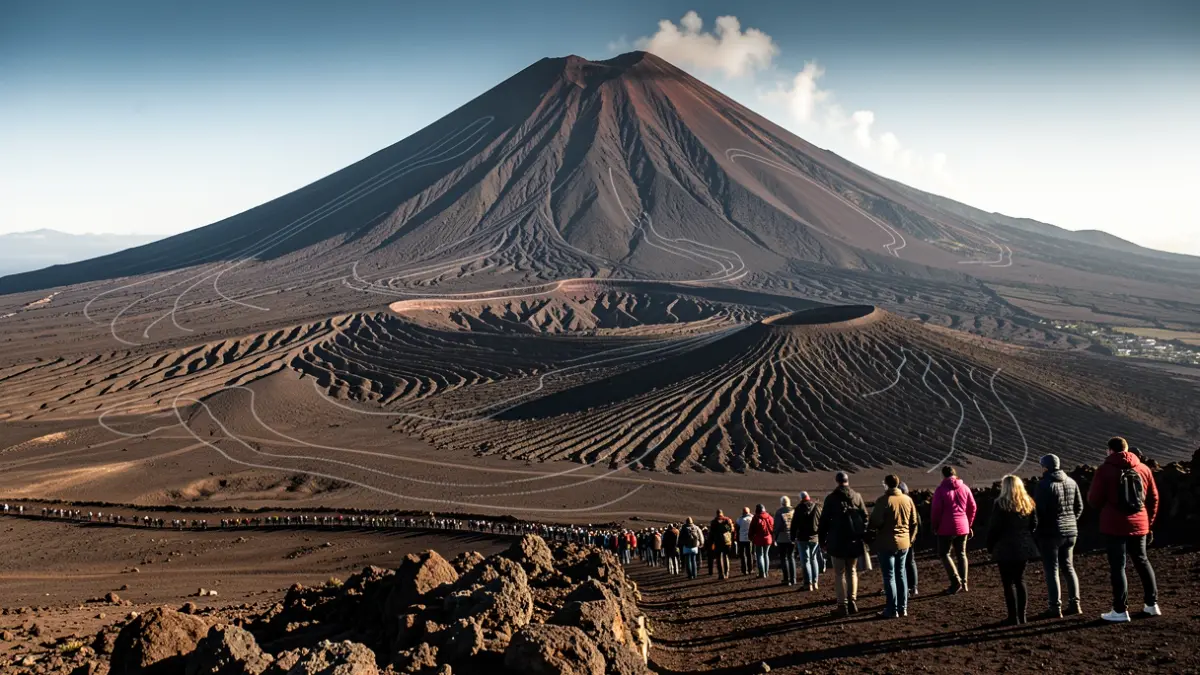
The highest concentration of these tremors, 611, was registered in the vicinity of Las Cañadas del Teide. During this period, the seismic monitoring network captured an intense swarm of small earthquakes between July 22nd and 24th.
According to Itahiza Domínguez, director of the IGN in the Canary Islands, this increase is partly due to improvements in the seismic network's ability to detect very low-magnitude earthquakes that previously fell below the localization threshold. Some of these events also slightly exceeded the magnitude of previous months, allowing for their individual inclusion in the seismic catalog.
Domínguez explained that while thousands of low-magnitude events associated with hybrid swarms were detected in February, only 93 could be located. In July, although there were also thousands of small events, a significant portion could be precisely located, including some with a magnitude of zero-plus.
The earthquakes recorded in July within Tenerife remained very small, ranging between 0.2 and 1.9 mbLg, with a maximum depth of 25 kilometers. Activity notably intensified between July 23rd and 24th, with over 380 earthquakes located southwest of Las Cañadas del Teide.
This episode is part of a sequence that began in February, with peaks of volcano-tectonic, low-frequency, and hybrid events, particularly around Pico Viejo and western Las Cañadas. The western sector of Las Cañadas del Teide has been the scene of similar episodes in previous years, such as 2016, 2019, 2022, 2024, and 2025.
The IGN considers the background behavior significant, indicating that the island's average seismic activity has remained above usual levels since February. Monthly data reflect this trend, with a progressive increase from March (223 earthquakes) to July (641).
Despite the apparent difference in figures, Domínguez warns that catalogs are not entirely homogeneous, and an event previously recorded as part of a swarm without individual localization might now appear as an independent seismic event. However, the background trend remains upward.
Regarding future evolution, the IGN urges perspective. Although activity has been low in recent weeks, a more prolonged analysis is needed to determine if the decrease is sustained or if the island's average activity will continue to rise.