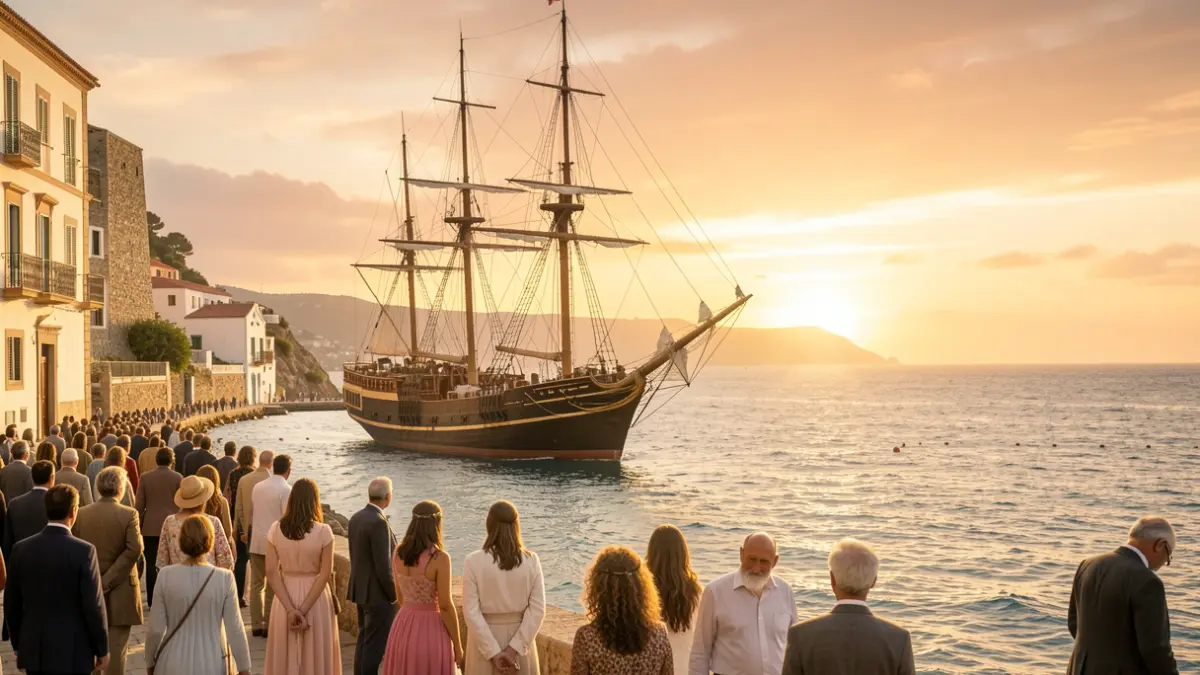
In the early hours in his hometown, Puerto de la Cruz in Tenerife, memories evoke silent farewells. Youngsters, including the author, would wake to hear neighbors and relatives preparing to travel to Caracas, when Venezuela was perceived as a land of immense wealth. These men, workers who trusted the author's mother, known as doña Juana, received their travel permits from her. She was a figure of trust, assuring them of their arrival in a new world, perhaps never to return.
Those times were described as dark, and Venezuela, particularly Caracas and other cities with job opportunities, was considered a transparent place in America. The author, still a boy, witnessed advice, warnings, and emotional goodbyes filled with uncertainty and fear as the house door closed with a choked farewell.
For a time, there was no news from some of these men, and uncertainty about their fate was high. Some failed in their pursuit of a new life, far from the poverty left by the Spanish Civil War. The author's neighborhood was one of the departure points for many emigrants whose primary destination was the Republic of Venezuela.
On one of his first journalistic assignments, the author visited El Hierro, an island that seemed a mirror of the world left behind. There, he found a house with a large sign that read: 'Gracias, Venezuela' (Thank you, Venezuela). This gesture of gratitude, according to the author, remained in the hearts of those who returned to the islands after finding salvation in Venezuela.
In those years, as Venezuela generated prosperity for Canarians, the author, as a young student, helped illiterate women write letters to their emigrated relatives. These letters typically began with expressions of health and well-being, followed by descriptions of the harsh conditions they had left behind and the hope that only Venezuela could offer.
Over time, the emigrants' homes improved thanks to the money sent. Some returned rich, others poor, and some decided to settle permanently on the islands. The author also visited Venezuela, experiencing firsthand the joy that infected the Canarian emigrants, making the islanders feel eternally grateful to the country.
As years passed, the hopes and journeys of the past began to crumble. Venezuela's situation changed drastically, transforming from a land of opportunity to a place where hope and joy are diminished. The country, described as difficult and broken, is no longer the admired place it once was.
In recent decades, Venezuela has become a complicated country. The idea that it was no longer what it used to be was hard to accept, and for some in Spain, talking about Venezuela seemed to be associated only with followers of specific political figures. However, the author emphasizes that Venezuela was, and is, the country of emigrants, part of their blood and history.
Recently, news of the crisis in Venezuela reached Spain and Europe, describing cities and the capital as 'broken.' The author reflects that it is people and their hearts that suffer, and that countries are their people. Venezuela's current situation is that of a devastated place awaiting the world's embrace.
The heart of Venezuela, according to the author, now receives a letter of hope, like those he wrote in his childhood, remembering the country that brought joy and saved many. The gratitude of the Herreño emigrants, who left the sign 'Gracias, Venezuela' on the houses they built, endures as a testament to that past.