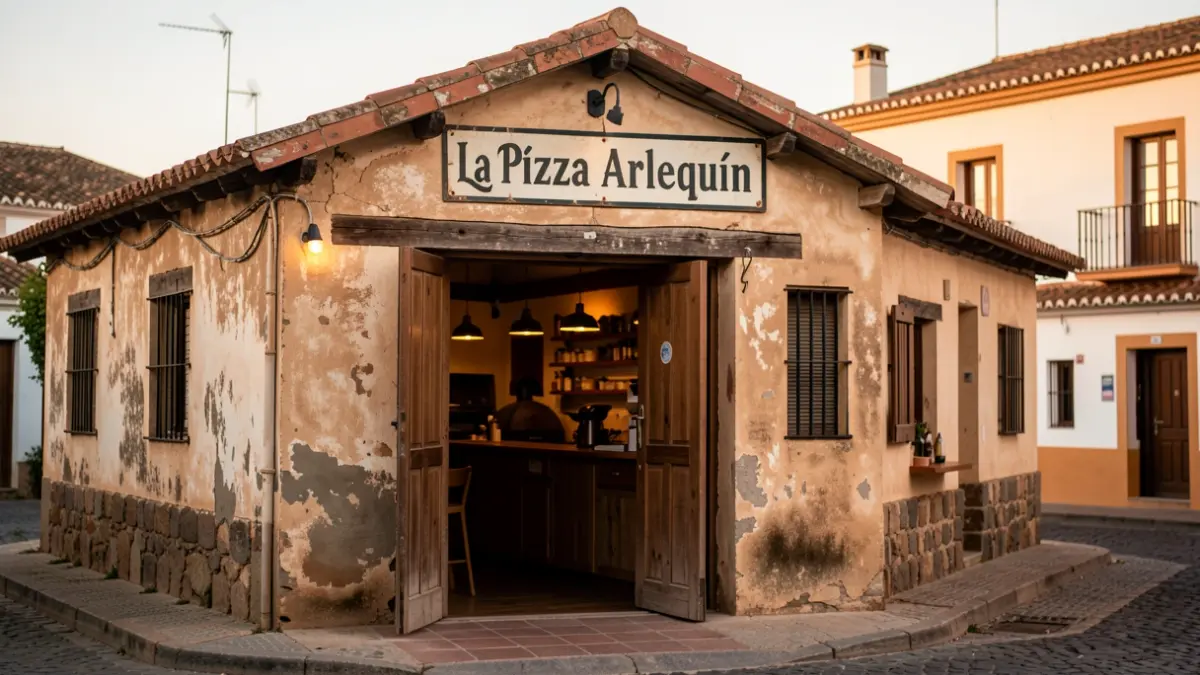
The urban landscape of large cities often devours traditional businesses at an alarming rate, but small enclaves capable of stopping time exist. In the heart of Las Palmas de Gran Canaria, a former garage on Tomás Miller street hides the origin of a gastronomic revolution that transformed consumption habits throughout the Archipelago. To speak of this corner is to speak of the first pizzeria in the Canary Islands, a pioneering establishment named Restaurante La Pizza Arlequín, which opened its doors in the distant October of 1965 and continues to operate today, consolidated as a living museum of the insular collective memory.
In the mid-sixties, the reality of the islands was completely different from today. Culinary globalization did not exist, and international dishes were considered true eccentricities reserved for television screens or cinema. Gran Canarian society knew of Italian cuisine more by hearsay than by palate. The person responsible for definitively breaking that cultural isolation was Jacques Böesser, a visionary emigrant of French origin who detected the hidden potential of a dark and narrow basement, transforming it into a meeting point with an unmistakable aesthetic personality.
Böesser's initial venture soon took root strongly among the neighborhood of the isthmus. The establishment progressively became the preferred setting for the youth of the 80s and 90s. Those generations recall with particular nostalgia the restaurant's atmosphere, characterized by dim indirect lighting, red candles, and rustic decoration that simulated the structure of an underground cave. It was the ideal space for first romantic dates, intimate family celebrations, and those endless conversations that shaped the future plans of the youth of the time.
As the seasons passed, the establishment's design has undergone logical modifications to adapt to contemporary regulations and tastes. Low-intensity lighting gave way to more functional brightness, and original decorative elements have been renewed, but the business's core identity remains unaltered. The great banner of the first pizzeria in the Canary Islands remains its imposing wood-fired oven, a classic piece of machinery from which thin, crispy, and artisanally crafted doughs continue to emerge, refusing to yield to the standardization of modern industrial processes.
The longevity of this establishment on Tomás Miller street should not be read as a mere anecdote in the restaurant sector. It functions, in reality, as a faithful thermometer of the socioeconomic evolution experienced by Canarian society. In just a few decades, the Archipelago went from having a very limited external dining offer to becoming a dynamic showcase of international cultures. In this context of opening to the Atlantic, the pizza format found its first home on the islands within the walls of La Pizza Arlequín.
The differential value that has sustained the business for sixty years of uninterrupted activity lies in its emotional heritage. It is not uncommon to observe during the summer months how the accents of European tourists mingle at its tables with the conversations of lifelong local customers. Many of those young people who visited in the seventies to discover an exotic dish now return accompanied by their children and grandchildren, passing on a culinary tradition that is part of their own personal biography. It is a generational transfer that new organized catering operators cannot artificially replicate.
The permanence of the first pizzeria in the Canary Islands demonstrates that resilience in hospitality is built on constancy, respect for original recipes, and strong roots in the neighborhood. Las Palmas de Gran Canaria, a city accustomed to reinventing itself and constantly looking towards the sea, finds in these historic eateries the perfect counterbalance to avoid losing its identity. As long as the iconic wood-fired oven on Tomás Miller keeps its embers lit, the city will preserve an essential fragment of its daily history, proving that authenticity remains the most valued ingredient by diners.