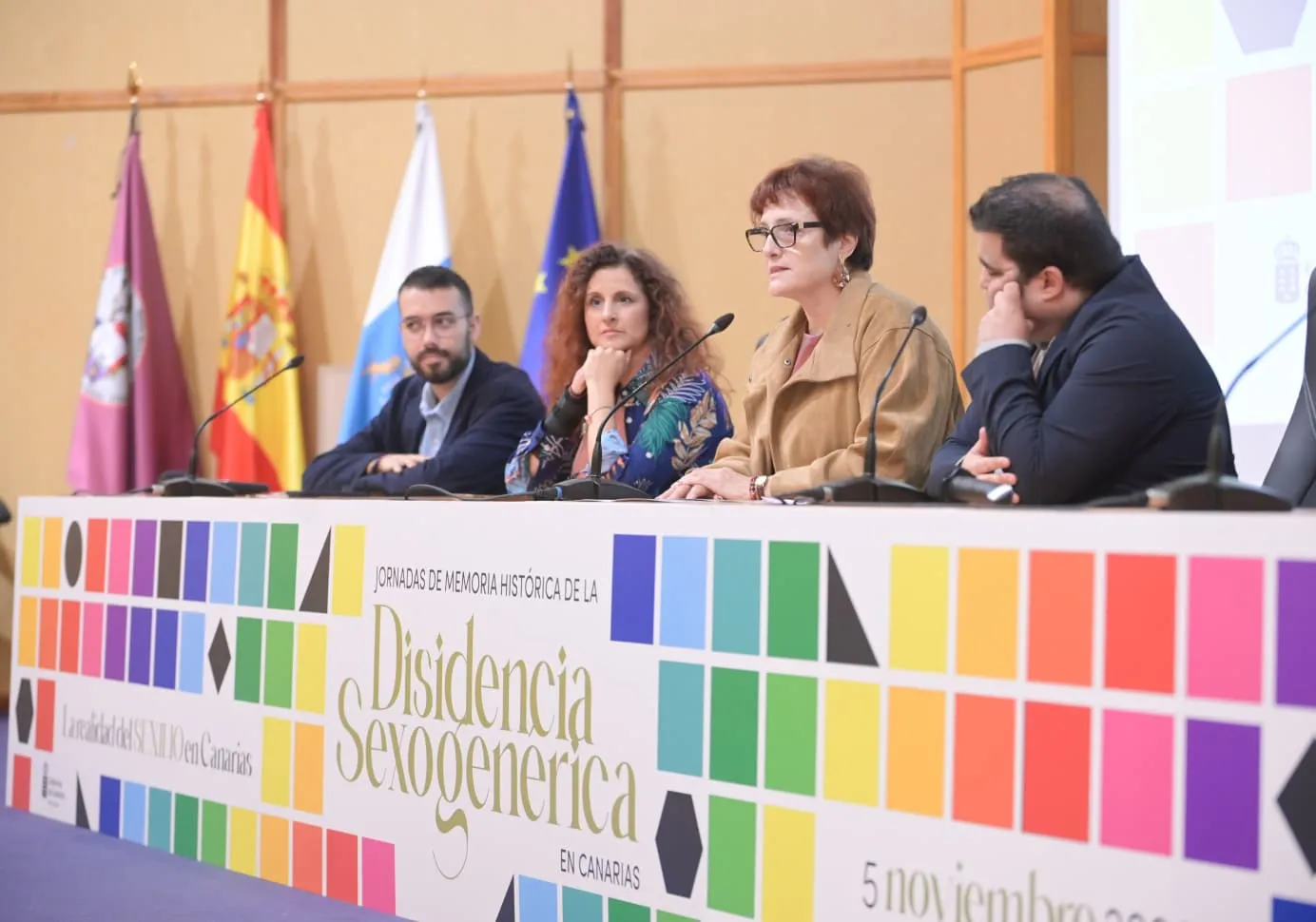
Candelaria Delgado Toledo, Minister of Social Welfare, Equality, Youth, Childhood, and Families of the Government of Canarias, highlighted during the inauguration of the fourth edition of the ‘Journeys of Historical Memory of Sex-Gender Dissidence in Canarias’ the importance of “talking and reflecting on the repression that the LGTBI+ collective experienced for so many years, in Canarias and elsewhere in the world, so that it is not repeated”.
These conferences are part of the second International Congress held by the University of La Laguna, “In)visible Lives Migrant Genders, Sexiles, and Masculinities”. The primary objective, as explained by Delgado, is “that there be no step backward” in the rights of the LGTBIQA+ collective in Canarias, assuring that they will fight against any attempt to regress.
The minister announced that public policies on diversity have been reinforced and “will also be reflected in next year’s budgets”. She also recalled the new Divercan program, aimed at strengthening the social support currently provided to the collective by entities, by financing the hiring of social workers.
In the same vein, the Director General of Diversity, Celso Mendoza Negrín, stated that this meeting “places the reality of sexile in the Archipelago at the center of the debate”. He added that the Government of Canarias reinforces its commitment to the visibility of sex-gender diversity, the recovery of historical memory, and the construction of a society where equality of rights and respect for all identities are effective principles of coexistence. Mendoza also expressed the need to “pay homage to all those people who have had to suffer sexile and continue to remember all the work being done by this autonomous community and other places so that it is not forgotten”.
The initiative, held throughout the morning in the Main Hall of the General Classroom Building on the Guajara Campus, brought together specialists from the academic field, institutional representatives, and representatives of collectives linked to diversity. It delved into the historical memory of LGTBIQ+ people, the consequences of repression during Francoism and democracy, and the experiences of those forced to leave their places of origin due to their sexual orientation or gender identity.
The program addressed different dimensions of historical memory and sexile with interventions such as: ‘A Canarian Kaleidoscope for the Archive of Trans-Hispanic Sexiles’, by Rafael Mérida Jiménez, Doctor from the University of Barcelona and professor and researcher at the Universities of Lleida and Barcelona; and ‘Sexile in Spain. Research and Report from the Ministry of Equality’, delivered by Ignacio Elpidio Domínguez Ruiz, Doctor in Anthropology from the Autonomous University of Madrid. Larisa Pérez Flores, Doctor in Philosophy, Culture, and Society from the University of La Laguna, addressed the relationships between bodies, islands, and displacements in the presentation ‘Bodies, Islands, and Displacements. ‘Queer’ Lives and Sexile in Canarias’.
The meeting concluded with a round table on migrants in situations of sexile, moderated by José Antonio Ramos Arteaga and with the participation of representatives from Diversas, Colectivo Gamá, ALTHAY, LIBERTRANS, and LÁNZATE.