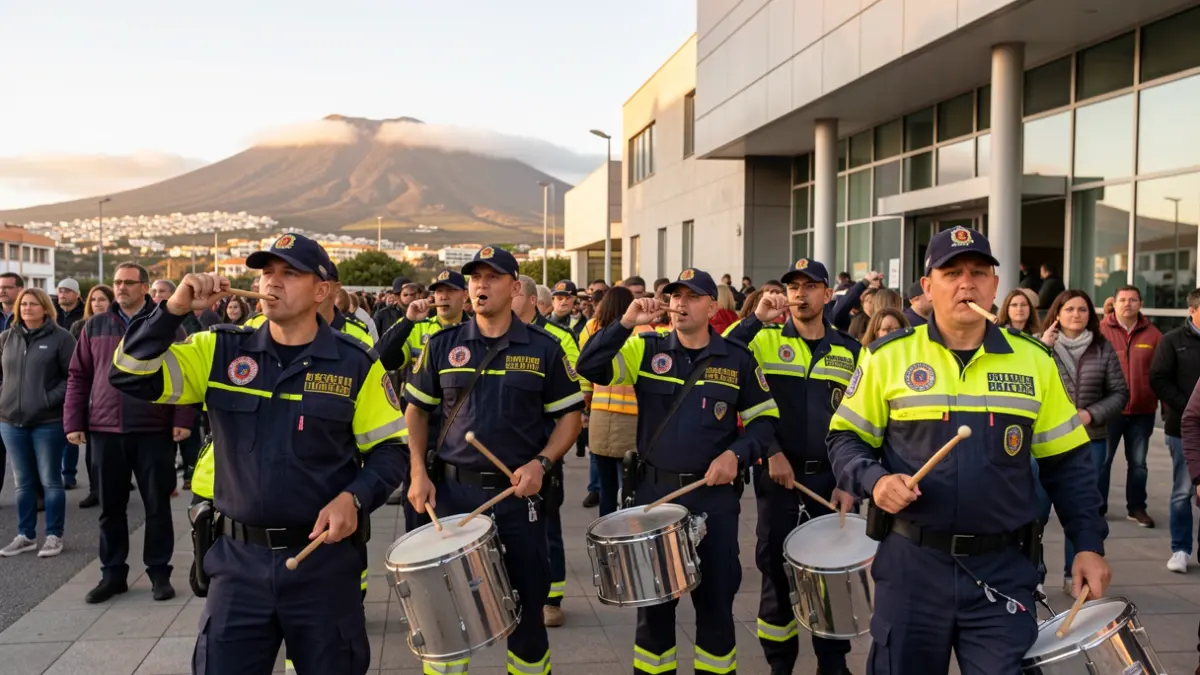
More than fifty urgent health transport workers gathered this Thursday in front of the Canary Islands Government headquarters in Las Palmas de Gran Canaria. They denounce the blockade in their collective agreement negotiations and request mediation from the regional Executive. The protesters, equipped with drums and whistles, hold both employers and the regional government responsible for what they describe as an 'unsustainable' labor situation, with salaries frozen for seven years and, according to their claims, below the interprofessional minimum wage (SMI).
Emergency medical technicians (EMTs) are demanding a 25% salary increase to compensate for the loss of purchasing power accumulated since 2019. Furthermore, they seek effective recognition of their professional category and improvements in labor rights related to working hours and permits.
“"Employers have hijacked the collective agreement"
José Miguel Perdomo, a representative of the Unión Sindical Obrera (USO) in Canarias, stated that the agreement expired on December 31, 2024, and negotiations remain blocked. He denounced that while employers have received IPC updates and contract extensions, workers' salaries remain frozen.
Perdomo recalled that around 2,500 emergency medical technicians work in the Canary Islands. He requested that the Administration directly assume the management of health transport due to alleged breaches by the concessionary companies, arguing that employers sign agreements they then fail to respect.
Discontent is also directed towards the Department of Health. Francisco Carnicer, a delegate from the strike committee of Comisiones Obreras, criticized recent statements by the minister Esther Monzón, who had called for understanding between unions and companies. According to Carnicer, during a conciliation hearing on June 5, companies indicated they would not assume salary improvements without an increase in service funding from the regional government.
“"They are passing the buck to each other. Employers say they won't contribute a euro if the government doesn't provide more money, while the administration asks us to reach an agreement with them."
Union representatives claim they have been negotiating for a year without progress and denounce that many workers rely on a hundred-euro salary supplement to reach the minimum wage. Carnicer lamented that the specific qualification required for the position is not reflected in their professional classification, feeling considered 'mere stretcher-bearers and drivers' instead of 'emergency medical technicians, qualified personnel'.
The workers emphasize their role as the first point of assistance for emergencies activated through 112. They believe the lack of professional recognition contrasts with the daily responsibility they undertake, being 'on call 24 hours a day for the citizens' without being considered health personnel.
The protests will continue. Following this Thursday's partial strike, new gatherings have been called for June 30 in front of the Parliament of Canarias in Tenerife, and on July 3, coinciding with the meeting of the Health Sectorial Table.
Urgent health transport in the Canary Islands is managed by private concessionary companies, including the UTE formed by Acciona and Icot Servicios, Iscan Servicios Integrales, and Tasisa. Unions insist that the negotiation deadlock can only be resolved with direct involvement from the regional government, while companies link economic improvements to increased public funding of the contract.